

Introduction: Understanding the ERP Data Gap
Agentforce is designed to help people get work done faster within Salesforce by using data that reflects real business operations. When ERP systems such as NetSuite are connected to Salesforce, Agentforce can access up-to-date ERP records on sales orders, inventory, financial status, and other operational details. With this information, agents can support tasks, answer questions, and trigger or assist with workflows based on current facts rather than incomplete or outdated information.
At the same time, the usefulness of Agentforce depends entirely on how complete and current the ERP data is in Salesforce. If NetSuite data is missing, delayed, or inconsistent, Agentforce cannot provide reliable results for tasks that rely on those records. Ensuring ERP data is accurate, synchronized, and properly structured within Salesforce is therefore essential before these agents can be used effectively for operational processes.
In this article, you will learn how gaps in ERP data affect the accuracy of operational responses, practical steps for connecting Salesforce NetSuite, and how complete and current information allows Agentforce to provide trustworthy answers that reflect real business conditions.
- Why AI Responses Depend on Accurate Data
- Common ERP Data Inconsistencies and Their Impact
- Lack of Real‑Time Data: A Practical Constraint
- Turning ERP Data Into Actionable Answers
- Bringing NetSuite Data Into Salesforce for Agentforce
- Benefits of Accurate ERP Data for Agentforce
- Example Use Case
- Extending Breadwinner: Agentforce Accelerator for NetSuite
- Conclusion: Making ERP Data Work for Smarter Operational Insights
Why AI Responses Depend on Accurate Data
When the NetSuite data available in Salesforce is incomplete, outdated, or inconsistent, AI responses can become misleading or incomplete, even if they appear confident. This can lead to several practical problems:
- Providing incorrect status updates for customer orders may cause confusion or unnecessary follow-ups.
- Suggesting actions that do not reflect the real operational reality, such as recommending shipments that are already completed or payments that have already been made.
- Offering guidance based on assumptions rather than verified records can result in decisions that are inefficient or even counterproductive.
For instance, AI might indicate that a shipment is still pending when it has already been processed in NetSuite, or recommend sending a payment reminder that has already been handled but has not yet been updated in Salesforce. Users relying on these responses could take unnecessary steps, wasting time and resources.
Accurate ERP data in Salesforce is therefore essential to ensure that AI responses are not just plausible, but trustworthy and actionable. Without proper NetSuite integration with Salesforce, even the most advanced AI tools can produce answers that seem confident while being disconnected from reality, reducing both operational efficiency and user confidence.
Common ERP Data Inconsistencies and Their Impact
The NetSuite ERP data model is rich and complex. It stores many different types of operational information and often has multiple modules that need to work together. When this data does not sit fully or consistently in Salesforce, the gap can create real problems.
Common sources of inconsistency include:
1. Orders Recorded Incorrectly or Multiple Times
If a sales order is duplicated or entered inconsistently between NetSuite and Salesforce, teams may encounter two versions of the same order or conflicting statuses. This can cause confusion when checking fulfillment, shipments, or delivery timelines, and may result in incorrect answers when operational tools like Agentforce try to provide insights.
2. Invoices Delayed or Missing
Invoices that exist in NetSuite but are not synchronized to Salesforce create gaps in billing information. Users seeking details on payments, invoice amounts, or aging invoices may not get accurate answers, which can affect collections, follow-ups, and financial planning.
3. Outdated Customer or Product Records
Customer profiles, addresses, credit limits, product descriptions, or pricing can change in NetSuite without being reflected in Salesforce. When Salesforce holds outdated information, questions about customer status, product availability, or order eligibility can produce incorrect or misleading responses.
4. Inconsistencies Across ERP Modules
NetSuite connects multiple areas of operational data. For example, an order’s status may depend on approvals, inventory reservations, or fulfillment workflows. If related records are not synchronized in a coordinated way, Salesforce may show only partial updates, leading to a fragmented or inaccurate view for AI-powered tools.
5. Data in Different Formats or Systems
NetSuite data may use different formats or structures compared to Salesforce records. Without proper harmonization, this can lead to Agentforce issues and reduce the reliability of answers about orders, payments, or inventory.
These kinds of data gaps can have a bigger impact than expected because operational questions require current, consistent, and aligned information. When even a single field is missing or outdated, responses based on those records become less reliable.
Lack of Real‑Time Data: A Practical Constraint
Operational tools are most useful when their responses reflect the current situation. Recent industry observations show that a substantial number of organizations struggle to provide AI tools with real‑time data.
Insight:
Lack of real‑time access to operational data directly affects AI performance.
In fact, 41% of organizations report that AI models cannot deliver timely insights because the data is not up to date, while less than half of business leaders (46%) feel confident they can achieve their AI goals due to concerns about data quality.
Together, these numbers show a clear link: without accurate, current data, even advanced AI tools struggle to generate reliable outputs.
These figures highlight a clear connection: when the source data is outdated, disconnected, or incomplete, even well‑designed tools cannot produce reliable responses. In practical terms, this means that internal teams may repeat manual verification steps, double‑check records, and hesitate to act on answers until they confirm them manually.
Closing these data gaps is therefore not just a technical exercise, but a necessary step to make operational responses dependable and to reduce the amount of manual rework required.
Turning ERP Data Into Actionable Answers
Once ERP data is properly available in Salesforce, Agentforce data integration helps users make sense of complex operational information without manually checking multiple records. Instead of showing raw data, it interprets it and provides clear, actionable answers.
Some ways Agentforce adds value include:
- Quickly monitoring order management using Agentforce for specific customers, allowing users to know exactly which orders have been shipped, which are still pending, and which might require immediate attention.
- Highlighting payments that are overdue or partially processed, so finance and sales teams can take timely action to avoid missed revenue or customer confusion.
- Identifying potential inventory issues before they impact shipments, helping operations plan ahead and prevent stock shortages or delays in fulfilling orders.
- Summarizing key operational metrics across multiple accounts or orders, giving a clear view of overall performance without having to manually compile data from different records.
- Flagging discrepancies between expected and actual shipments or deliveries, enabling users to investigate issues quickly and prevent operational bottlenecks or customer dissatisfaction.
For instance, a user could ask: “Which orders are delayed this week?” Agentforce can provide a direct list with the status of each order, eliminating the need to manually cross-check NetSuite and Salesforce records. Another example: asking about a customer’s outstanding balance will immediately show what is unpaid, reducing errors and follow-ups.
Bringing NetSuite Data Into Salesforce for Agentforce
To provide accurate responses, Agentforce needs ERP data to be available in Salesforce. There are several approaches to bringing NetSuite data into Salesforce, including custom integrations or middleware, but the most reliable and maintainable solution is to use dedicated connectors from the AppExchange.
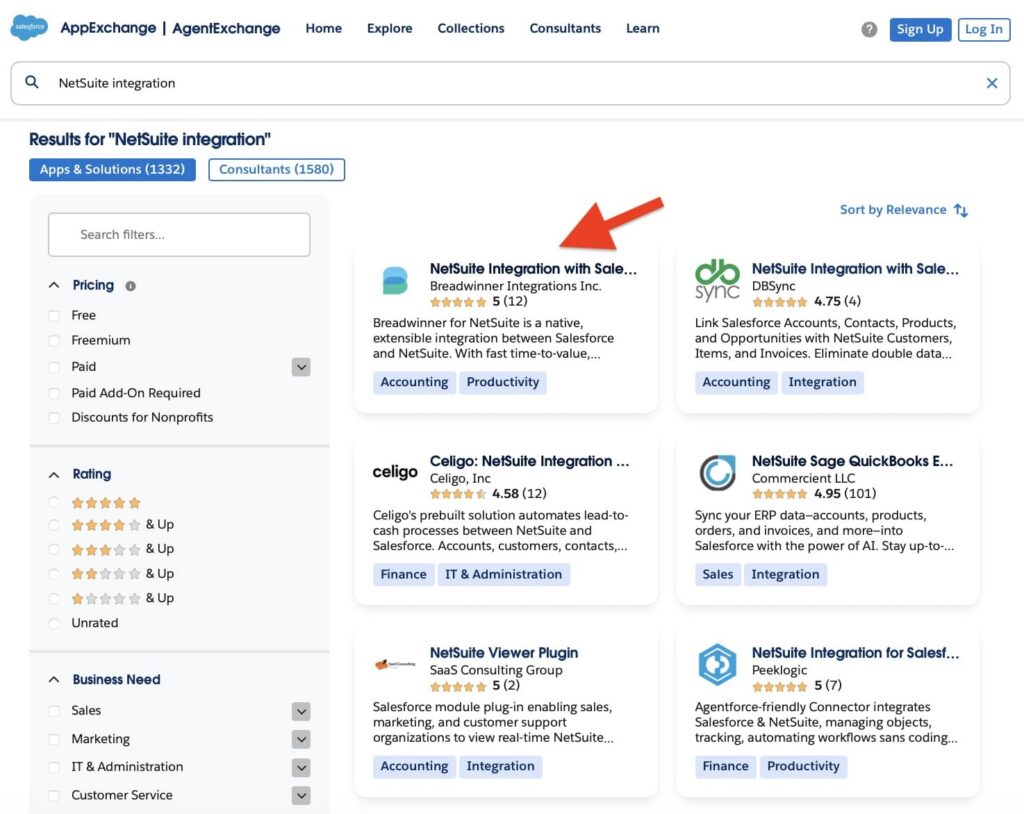
These tools are designed to synchronize key records, ensuring that Salesforce has the correct information for Agentforce to work with.
We looked at the available connectors on the AppExchange and found Breadwinner, which replicates data from NetSuite into Salesforce objects, including sales orders, companies, payment information, and items, making the data available for reporting, automation, and workflow processes.
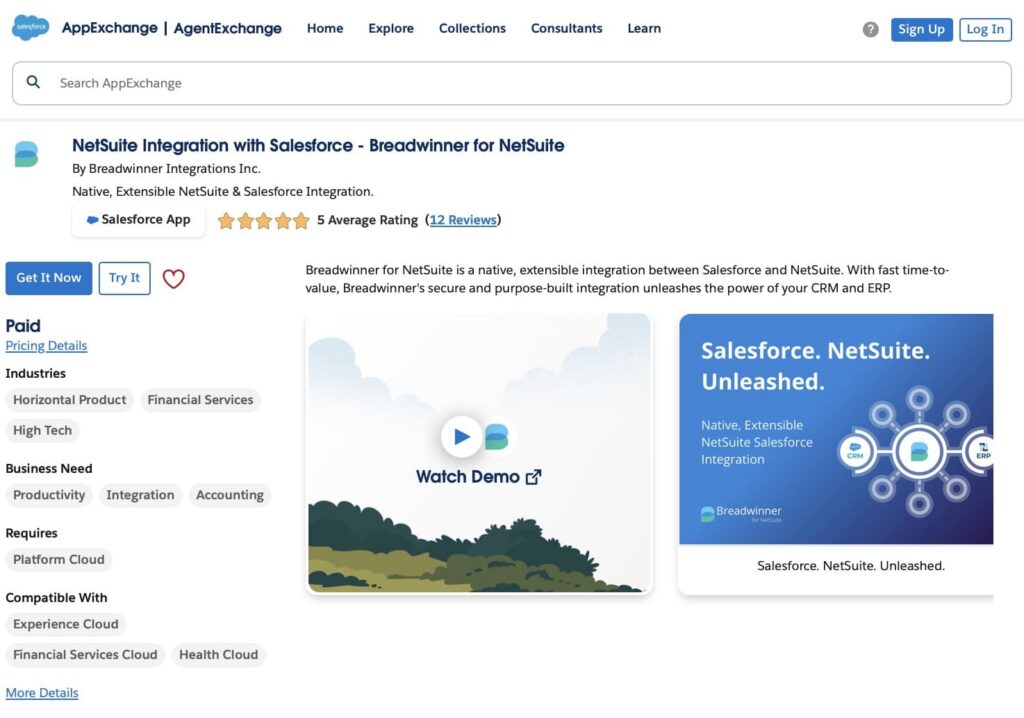
Using a connector like Breadwinner ensures that:
- Sales orders and items are consistently up to date in Salesforce.
- Financial and operational data is accurately represented for AI queries.
- Users do not have to manually reconcile ERP and Salesforce records.
For Agentforce, this means AI responses are based on actual, current ERP data, rather than partial or outdated snapshots. Breadwinner provides a straightforward way to bring the necessary ERP records into Salesforce, making it easier for Agentforce to provide actionable and reliable answers.
By leveraging the Salesforce connector for NetSuite, organizations can reduce Agentforce known issues caused by missing information and ensure that it can function as intended.
Benefits of Accurate ERP Data for Agentforce
When NetSuite data is properly synchronized in Salesforce, Agentforce can work effectively on operational questions. Breadwinner enables you and your team to query NetSuite customer data in Agentforce, making it possible to access up-to-date information without switching systems. Some of the advantages include:
1. Verify sales order fulfillment quickly: Users can check the status of sales orders without switching systems, allowing them to confirm shipments, backorders, or pending approvals directly from Salesforce.
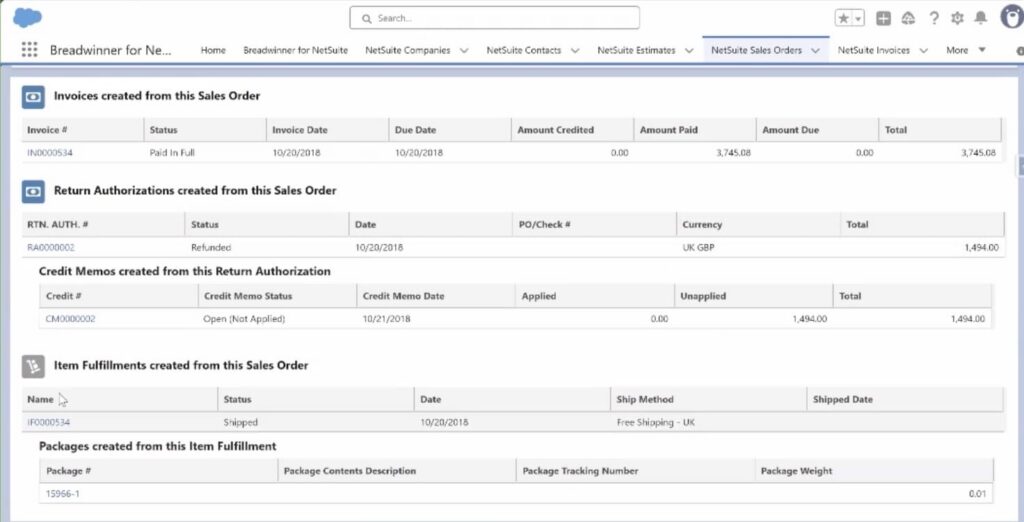
2. Track payment status accurately: With invoice and payment details brought from NetSuite, Agentforce can highlight overdue or partially processed payments, helping finance and sales teams act before issues escalate.
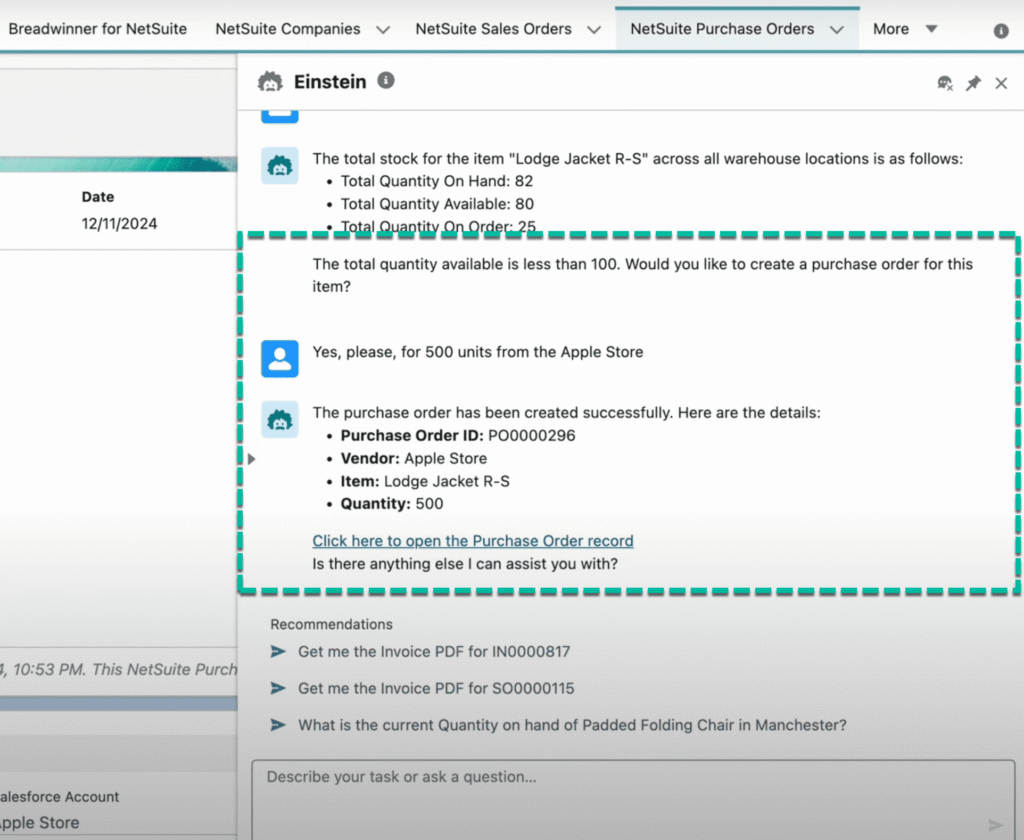
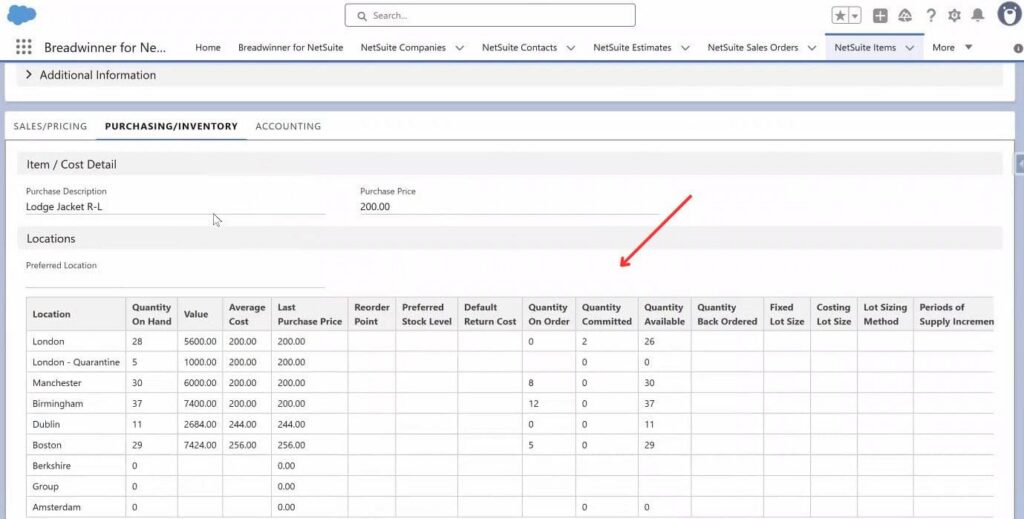
3. Anticipate issues in inventory management using Agentforce: Current stock levels, reservations, and shipment statuses enable Agentforce to flag potential inventory shortages or bottlenecks early, reducing disruptions in order fulfillment.
4. Summarize operational metrics across records: Agentforce data can consolidate information from multiple orders or accounts to provide a clear overview of KPIs, such as total orders pending, invoiced amounts, or shipment volume.
5. Identify discrepancies: Differences between expected and actual shipments, invoice amounts, or payments can be highlighted, supporting faster investigation and corrective action.
6. Reduce manual work and errors: Automation of repetitive checks and comparisons between Salesforce and ERP data reduces the risk of human mistakes and frees up time for higher-value tasks.
7. Support contextual decisions: Teams can make decisions based on accurate, current ERP data within Salesforce, whether it’s prioritizing orders, managing fulfillment schedules, or planning financial actions.
8. Improve customer experience: Faster and accurate responses regarding order status, payments, or deliveries enhance service quality and prevent misinformation from reaching customers.
9. Enable scalable workflows: As more records and data are synchronized from NetSuite, Agentforce can scale to answer more operational questions consistently across the organization.
10. Provide reliable insights for cross‑functional teams: Finance, sales, and operations teams work from the same data foundation, ensuring that answers generated by Agentforce are trusted and actionable.
Example Use Case
A company manages orders and inventory in NetSuite while using AI tools to support stock replenishment decisions and operational planning.
Scenario without up-to-date ERP data in Salesforce:
- The Agentforce only has access to partial, outdated, or incomplete order information.
- As a result, stock recommendations may be inaccurate, potentially leading to overstock in some locations or shortages in others.
- Staff members must spend additional time manually reviewing, correcting, or reconciling AI suggestions with the actual NetSuite data, which slows down decision-making and increases the risk of errors.
Scenario with Agentforce and a connector like Breadwinner:
- Salesforce receives synchronized NetSuite data, including current sales orders, invoice details, inventory levels, and shipment status.
- Agentforce can leverage this accurate and timely data to provide operational insights and guidance.
- The AI tool can now generate stock replenishment recommendations based on real, up-to-date information.
- Staff can rely on these insights without spending hours cross-checking records, freeing them to focus on more strategic tasks such as planning, customer communication, or exception handling.
Extending Breadwinner: Agentforce Accelerator for NetSuite
Breadwinner also offers Breadwinner for NetSuite Agentforce, which lets Agentforce use NetSuite data directly in Salesforce conversations. This enables teams to ask about invoices, orders, or inventory and get accurate, current information without switching systems.
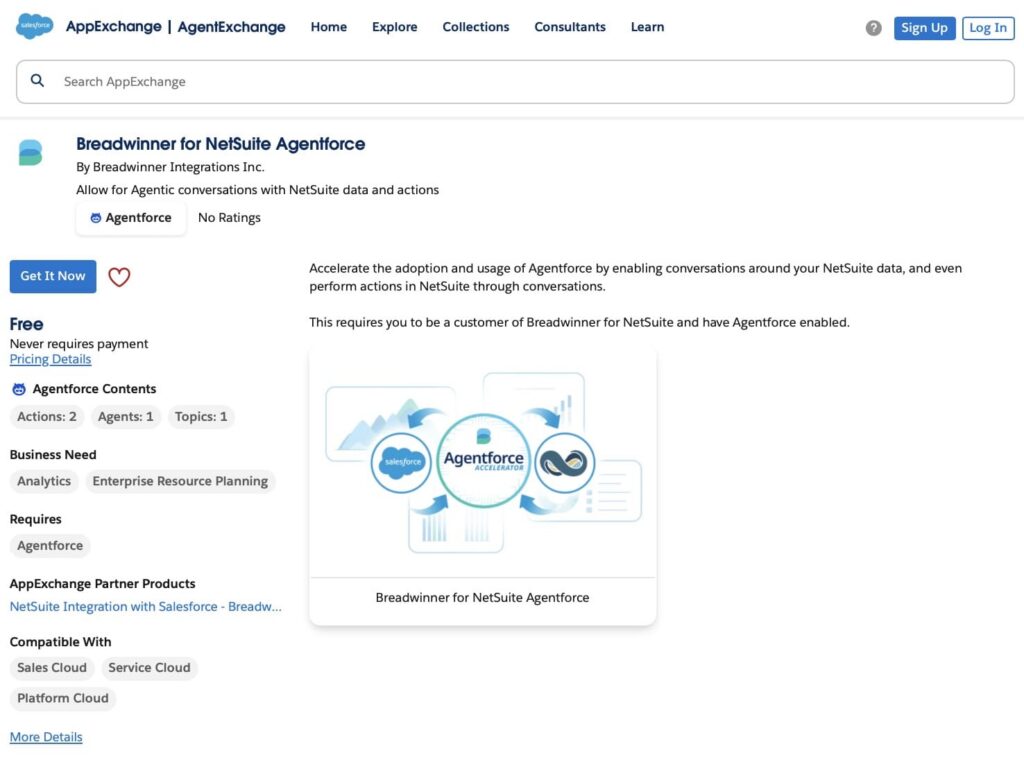
With the Accelerator:
- Agentforce can reference real NetSuite financial and operational records.
- Customers, partners, and internal staff can interact with ERP data through conversational queries.
- Teams can act on the data in Salesforce, improving workflow efficiency and decision-making.
The Accelerator is free to use, allowing teams to see how synchronized ERP data enhances AI responses and operational tasks.
Conclusion: Making ERP Data Work for Smarter Operational Insights
Reliable operational insights depend on having accurate and up-to-date ERP data. When NetSuite information is incomplete or not reflected in Salesforce, it can cause Salesforce Agentforce issues, leading AI tools to produce recommendations or responses that do not match reality and affecting decisions around orders, inventory, and payments.
Accurate and complete data is essential for Agentforce, ERP related operations and for proper Agentforce data access, ensuring AI systems can provide meaningful operational guidance. Tools like Breadwinner integrate NetSuite and Salesforce data, including sales orders, items, payments, and inventory, giving Agentforce the foundation it needs to deliver accurate responses.
With properly synchronized ERP data, companies can:
- Reduce errors in AI-driven outputs
- Make operational decisions based on actual records
- Get a clearer, consolidated view of order, inventory, and financial status
- Rely on AI to provide insights that reflect real business conditions
Closing the ERP data gap makes operational AI tools far more practical and trustworthy for daily decision-making. For organizations looking to see how ERP data can improve AI accuracy, getting a free trial of Breadwinner is a straightforward way to experience the benefits of synchronized NetSuite data in Salesforce directly.

Antonina is a Salesforce Admin with six certifications: Salesforce Certified Platform Foundations, Platform Administrator, Platform Administrator II, CPQ Administrator, AI Associate, and Agentforce Specialist. She started working with Salesforce in 2021 as Intern Salesforce Developer. Now, a 2-Star Ranger on Trailhead, she continues to expand her skills and knowledge. She helps manage Salesforce systems, automate tasks, and improve processes. Antonina loves learning new things and exploring better ways to use technology. In her free time, she enjoys reading, playing sports, and exploring new tech ideas.
 Previous Post
 Next Post