


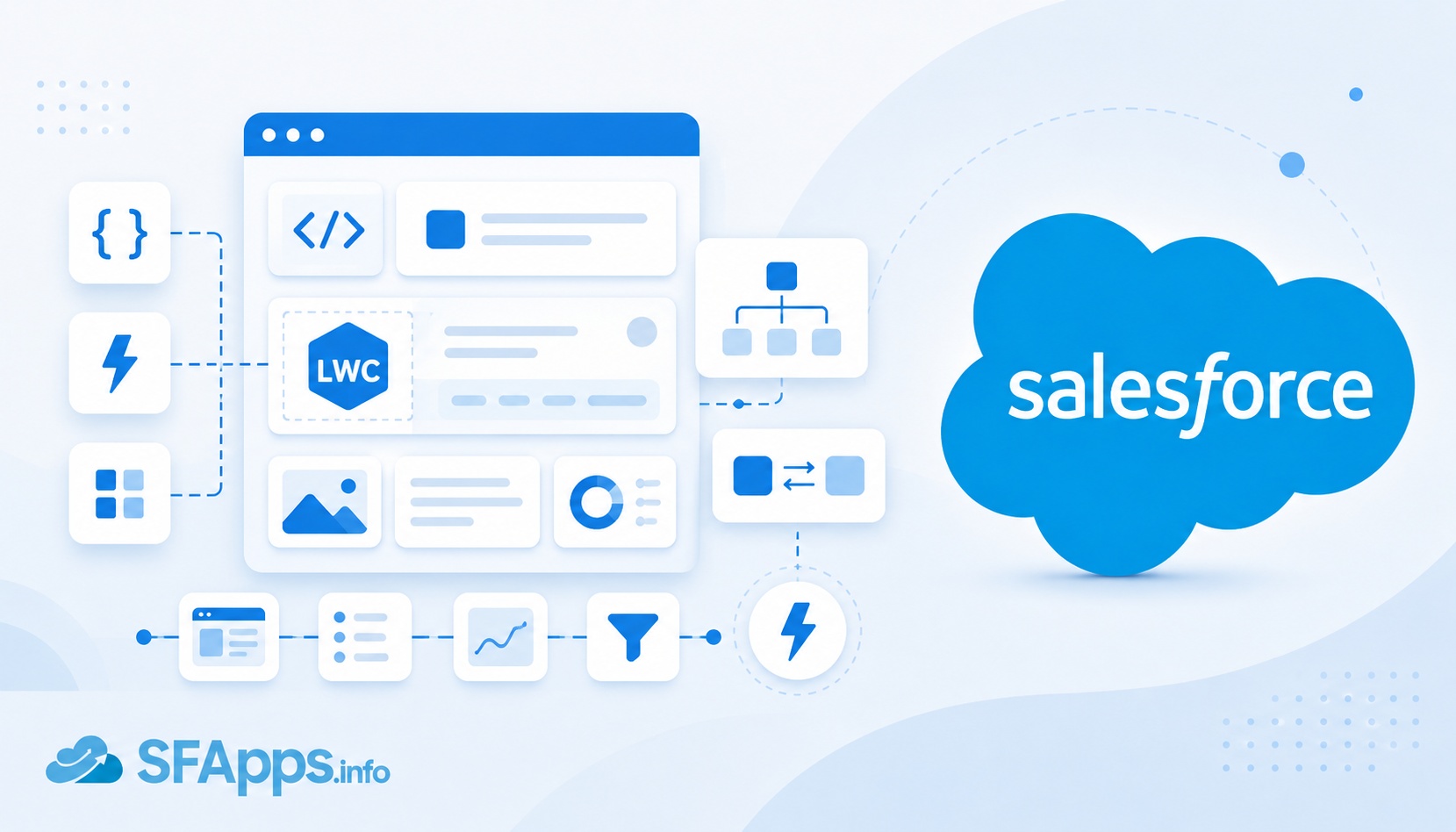
Salesforce Lightning Web Components (LWC) remains a foundational framework for building modern, dynamic user interfaces on the Salesforce Platform using standard web technologies such as HTML, JavaScript (ES6+), and CSS. As enterprises continue embracing digital transformation, with Salesforce projected to generate over 9.3 million new jobs worldwide by 2026, driven by cloud adoption and ecosystem expansion, skills in Salesforce development, especially in modern frameworks like LWC, are strategically valuable for professionals aiming at high-growth roles in the tech industry. For developers preparing for salesforce lightning interview questions mastering LWC is increasingly essential.
Although overall hiring patterns in the Salesforce ecosystem have seen fluctuations, global demand rebounded by approximately 8% in 2025 after previous declines, developers still account for a substantial share of opportunities, representing roughly 23% of job listings even amid competition and market readjustments.
Looking ahead to 2026-2027, roles that require deep technical expertise (such as building and customizing Salesforce solutions using LWC) are expected to remain essential, particularly as organizations increasingly integrate AI, automation, and advanced Salesforce clouds into their operations, making LWC skills a competitive differentiator among candidates.
List of 110 Salesforce LWC Interview Questions and Answers
- Specific Scenario-Based Salesforce LWC Interview Questions with Answers
- How would you pass the list of records from ParentComponent to ChildComponent?
- How would you detect and handle a record selection in ChildComponent and ensure the parent component is only notified if the selection is different from the previous one?
- How would you handle the recordselected event in ParentComponent and access the selected record?
- How would you prevent ChildComponent from re-rendering unnecessarily if ParentComponent passes an identical list of records?
- How would you handle scenarios where multiple child components need to communicate their selected records back to ParentComponent?
- Junior Salesforce LWC Interview Questions and Answers
- Middle-level LWC Interview Questions and Answers
- Interview Questions and Answers for Experienced LWC Developers
- Scenario-Based Interview Questions for Salesforce LWC Developers
- Technical/Coding LWC Interview Questions
- 5 Tricky Salesforce LWC Interview Questions and Answers
- Resources for Better Preparation for Salesforce LWC Interview
Specific Scenario-Based Salesforce Lightning Web Components Interview Questions with Answers
In Lightning Web Components, you have a parent component (ParentComponent) and a child component (ChildComponent). ParentComponent has a list of records that it passes to ChildComponent. The requirement is to display the list in ChildComponent and allow the user to select one record from the list. When a record is selected in ChildComponent, an event should be fired to inform ParentComponent of the selection, but only if it is a different record than the previously selected one.
How would you pass the list of records from ParentComponent to ChildComponent?
Answer: In ParentComponent, define the list as a JavaScript property and pass it to ChildComponent through an HTML attribute bound to an @api property.
// ParentComponent.js
recordList = [...]; // your list of records
<!-- ParentComponent.html -->
<c-child-component records={recordList}></c-child-component>In ChildComponent, define an @api property:
// ChildComponent.js
import { LightningElement, api } from 'lwc';


export default class ChildComponent extends LightningElement {
    @api records;
}
This allows ParentComponent to pass recordList to ChildComponent for display.
How would you detect and handle a record selection in ChildComponent and ensure the parent component is only notified if the selection is different from the previous one?
Answer: In ChildComponent, track the previously selected record using its Id (instead of comparing objects). When a new selection is made, check whether the Id differs from the previously selected Id. If it changes, fire a custom event to notify ParentComponent.
// ChildComponent.js
previousSelectedId;


selectRecord(record) {
    if (this.previousSelectedId !== record.Id) {
        this.previousSelectedId = record.Id;
        this.dispatchEvent(new CustomEvent('recordselected', {
            detail: record
        }));
    }
}
This ensures the event is only fired if the selection changes.
How would you handle the recordselected event in ParentComponent and access the selected record?
Answer: In ParentComponent, handle the custom event in the template and access the selected record from event.detail.
<!-- ParentComponent.html -->
<c-child-component
    records={recordList}
    onrecordselected={handleRecordSelected}>
</c-child-component>
// ParentComponent.js
handleRecordSelected(event) {
const selectedRecord = event.detail;
// Handle the selected record
}// ParentComponent.js
handleRecordSelected(event) {
const selectedRecord = event.detail;
// Handle the selected record
}This allows ParentComponent to access the selected record whenever the selection changes.
How would you prevent ChildComponent from re-rendering unnecessarily if ParentComponent passes an identical list of records?
Answer: In LWC, unnecessary re-renders usually happen when a new array reference is created. To avoid this, ParentComponent should follow an immutable update pattern and only assign a new array when the data actually changes. ChildComponent should treat @api records as read-only and avoid mutating the list directly. Deep comparisons like JSON.stringify() are not recommended for large datasets.
How would you handle scenarios where multiple child components need to communicate their selected records back to ParentComponent?
Answer: In ParentComponent, assign each child component a unique identifier using a data-* attribute. In ChildComponent, include this identifier in the event detail so ParentComponent can determine which child triggered the selection.
<!-- ParentComponent.html -->
<c-child-component
    data-child-id="child1"
    onrecordselected={handleRecordSelected}>
</c-child-component>

<c-child-component
    data-child-id="child2"
    onrecordselected={handleRecordSelected}>
</c-child-component>
// ParentComponent.js
handleRecordSelected(event) {
const { record, childId } = event.detail;
// Use childId to differentiate between child component instances
}// ChildComponent.js
selectRecord(record) {
this.dispatchEvent(new CustomEvent('recordselected', {
detail: {
record: record,
childId: this.dataset.childId
}
}));
}This approach lets ParentComponent manage multiple selections without confusion among child instances.
Junior Salesforce LWC Interview Questions and Answers
Question 1: What is Salesforce LWC?
Bad Answer 1: Salesforce LWC is a Salesforce feature used to create pages. It is similar to Aura and works only in Salesforce.
Good Answer 1: Salesforce Lightning Web Components (LWC) is a modern framework for building UI components on the Salesforce Lightning Platform. It is based on standard web technologies such as JavaScript, HTML, and CSS. LWC uses native browser capabilities to improve performance compared to older Salesforce frameworks. It can also coexist with Aura components in the same Salesforce application. It can also coexist with Aura components in the same Salesforce application. Understanding this is essential when preparing for LWC interview questions Salesforce.
Question 2: Can you explain the difference between LWC and Aura components?
Bad Answer 2: Aura is better because it has more features, and LWC is newer but less useful.
Good Answer 2: LWC is a modern framework built on web standards, which makes it faster and easier to maintain. Aura is the older Salesforce component framework and relies on a proprietary programming model. LWC provides better performance due to lightweight architecture and native browser support. Aura is still used in legacy projects, but LWC is the recommended approach for new development.
Question 3: What are the key features of Lightning Web Components?
Bad Answer 3: LWC is fast and uses JavaScript.
Good Answer 3: LWC offers high performance by using native browser APIs and a lightweight component model. It supports modern JavaScript features such as ES6 modules, classes, and decorators. LWC components are reusable, modular, and follow a clean separation of logic and UI. It also integrates smoothly with Salesforce services like Apex, LDS, and the wire service.
Key LWC Features:
- Native browser rendering (faster UI)
- Component-based architecture
- Modern JavaScript support (ES6+)
- Built-in Salesforce integration (Apex, LDS, UI API)
Question 4: How do you pass data from a parent component to a child component in LWC?
Bad Answer 4: You can call the child component method directly from the parent and send values.
Good Answer 4: Data is passed from a parent component to a child component through public properties. The child component uses the @api decorator to expose a property that can receive data. The parent binds its variable to that property in the HTML template. This is the standard one-way data flow mechanism in LWC.
Question 5: What is the purpose of the @track decorator in LWC?
Bad Answer 5: @track is mandatory in every component to update UI.
Good Answer 5: The @track decorator is used to make a property reactive so that UI updates when its internal value changes. In modern LWC, primitive fields are reactive by default, so @track is mainly relevant when tracking changes inside objects or arrays. However, Salesforce has improved reactivity over time, so developers often rely on immutable updates instead. @track is still useful in specific cases but is not required everywhere.
Question 6: How do you handle events in LWC?
Answer 6: Events in LWC are handled using event listeners defined in the HTML template (such as onclick or onchange). Developers can also use addEventListener() in JavaScript for more advanced cases. LWC supports both standard DOM events and custom events. Custom events are commonly used for communication from child to parent components.
Question 7: What are some of the lifecycle hooks available in LWC?
Answer 7: Lifecycle hooks are methods that allow developers to run code at specific stages of a component’s lifecycle. For example, connectedCallback() is used when the component is inserted into the DOM. renderedCallback() runs after the component finishes rendering. These hooks help manage initialization, rendering logic, and cleanup tasks – important knowledge for lightning interview questions salesforce.
Question 8: What do you call an Apex method from a Lightning Web Component?
Answer 8: To call an Apex method from LWC, the Apex method must be annotated with @AuraEnabled. In JavaScript, the method is imported using @salesforce/apex/MethodName. It can be called imperatively using promises or reactively using @wire. This allows LWC components to retrieve, update, or process server-side Salesforce data.
Common Apex Call Approaches
| Approach | Best For | Example |
| @wire | reactive reads, caching | UI data display |
| Imperative call | user actions (button click) | save/update logic |
Question 9: What is a wire service in LWC?
Answer 9: The wire service is a reactive mechanism that automatically retrieves Salesforce data when parameters change. It is commonly used with @wire to call Apex methods or Lightning Data Service adapters. Wire service supports caching, which improves performance. It also makes UI updates automatic when data is refreshed or modified.
Question 10: How do you ensure data binding in LWC templates?
Answer 10: Data binding in LWC is done using curly braces {} in HTML templates. When the value of a reactive property changes, the template automatically re-renders. LWC uses one-way binding from JavaScript to HTML. For user input, developers capture changes through events and update the JS property manually.
Question 11: Can you explain the use of slots in LWC?
Answer 11: Slots allow a component to accept markup content from its parent component. This makes components more flexible and reusable, especially for layout and container components. LWC supports default slots and named slots. Slots are useful for building UI components like modals, cards, and dynamic layouts.
Question 12: How do you make an LWC component public or private?
Answer 12: An LWC property or method becomes public when it is decorated with @api. Public members can be accessed from a parent component or other external components. Without @api, all properties and methods remain private by default. This design ensures encapsulation and helps protect internal logic.
Question 13: What is the use of the @wire decorator in LWC?
Answer 13: The @wire decorator connects a component to Salesforce data sources such as Apex methods, UI API, or message channels. It automatically retrieves data and refreshes when parameters change. This improves performance due to caching and reduces the need for manual refresh logic. It is best used for read operations and reactive data scenarios
Question 14: How can you handle styling in LWC?
Answer 14: Styling in LWC is done using a .css file that is scoped to the component, meaning styles do not leak outside. Developers often use SLDS classes to ensure consistent Salesforce UI design. LWC also supports CSS custom properties for dynamic theming. For global styling, Salesforce provides shared SLDS utilities and design tokens.
Styling Options List
- Component-scoped CSS (component.css)
- SLDS utility classes
- CSS custom properties (design tokens)
- Inline styles (only if necessary)
Question 15: What is the role of @salesforce/schema in LWC?
Answer 15: @salesforce/schema allows developers to import object and field references directly from Salesforce metadata. This avoids hardcoding API names like Account.Name, reducing the risk of errors. It is often used with Lightning Data Service or UI API methods like getRecord. This approach makes code more stable and easier to maintain across org changes.
Question 16: How do you use JavaScript to manipulate the DOM in LWC?
Answer 16: DOM manipulation is possible in LWC using this.template.querySelector() or querySelectorAll(). However, Salesforce recommends avoiding direct DOM manipulation because it can conflict with the reactive rendering system. If DOM access is required, it should be done inside renderedCallback(). The preferred approach is always to update UI through reactive properties and template binding.
Question 17: What are some best practices for error handling in LWC?
Answer 17: Error handling should include capturing errors from Apex calls and displaying user-friendly messages. Developers should log technical errors for debugging but avoid exposing sensitive details to users. Toast notifications using ShowToastEvent are a common way to display errors. It is also important to handle both client-side and server-side errors consistently.
Question 18: How do you test Lightning Web Components?
Answer 18: Lightning Web Components are tested using the Jest framework, which is officially supported by Salesforce. Jest tests can validate rendering logic, event handling, and conditional UI behavior. Developers can mock Apex calls and wire adapters for unit testing. Testing helps ensure stability and reduces the risk of bugs during deployments.
Testing Coverage Checklist
- Rendering tests (template output)
- Event handling tests
- Apex mock testing
- Wire adapter mock testing
Question 19: Can LWC be used outside of the Salesforce platform?
Answer 19: Yes, LWC can be used outside Salesforce through the LWC Open Source project. This allows developers to build web components in any environment that supports modern JavaScript. However, Salesforce-specific modules such as Apex integration, LDS, and UI API are not available outside Salesforce. External LWC usage is mainly useful for experimentation or cross-platform UI development.
Question 20: What is the significance of the render() method in LWC?
Answer 20: The render() method allows developers to dynamically choose which HTML template should be used for a component. It is typically used when different layouts must be displayed depending on component state. This method is considered an advanced feature and is not commonly required for basic LWC development. If misused, it can reduce readability and make the component harder to maintain.
These questions cover the most important junior-level LWC concepts, including framework basics, decorators, lifecycle hooks, Apex integration, wire service, and testing. A strong understanding of these topics helps candidates demonstrate that they can build scalable and maintainable Salesforce UI solutions. Interviewers usually focus on whether the candidate understands reactivity, component communication, and Salesforce integration best practices.
For further preparation and related topics, see our detailed Salesforce Analyst Interview Questions for additional insights and practice.
Insight:
Many junior developers memorize definitions but struggle to explain why LWC behaves the way it does. In interviews, you can stand out by connecting each concept to real-world impact: performance, maintainability, and user experience. If you clearly explain when to use @wire vs imperative Apex calls and how parent-child communication works, you will appear much more confident and job-ready.
Middle-level LWC Interview Questions and Answers
Question 1: How does the rendering lifecycle work in LWC?
Bad Answer 1: The component renders once and never changes unless you refresh the page.
Good Answer 1: In LWC, the rendering lifecycle begins with component creation (constructor()), followed by connectedCallback() when inserted into the DOM. The component then renders the template, and renderedCallback() executes after the DOM is updated. When reactive data changes, LWC triggers re-rendering automatically, ensuring UI stays in sync with state changes. Understanding this lifecycle is often tested in lwc salesforce interview questions.
Question 2: Explain how to use getters and setters in LWC.
Bad Answer 2: Getters and setters are only used to store values in the component.
Good Answer 2: Getters return a computed value and are re-evaluated whenever dependent reactive properties change. Setters allow you to run custom logic whenever a property value is updated. Using getters and setters helps implement reactive behavior, validate inputs, or transform data before rendering in templates.
Question 3: How can you optimize performance in LWC applications?
Bad Answer 3: Just avoid using JavaScript in templates and it will be fast.
Good Answer 3: Performance can be optimized by minimizing unnecessary re-renders, using the wire service efficiently, and leveraging lazy loading for heavy components. Reducing complex computations in templates and using immutable updates also helps. Additionally, caching frequently used data and avoiding direct DOM manipulation improves responsiveness.
Performance Optimization Checklist
- Minimize component re-renders
- Use @wire efficiently
- Lazy load heavy components
- Use immutable state updates
- Avoid direct DOM manipulation
Question 4: Describe the communication pattern between nested LWC components.
Bad Answer 4: Just pass all data from parent to child and call child methods directly.
Good Answer 4: Communication between nested components uses a combination of public properties (@api) for parent-to-child data flow, custom events for child-to-parent notifications, and the pub-sub pattern for sibling or disconnected component communication. This approach maintains decoupled components and ensures maintainable data flow. Using events rather than direct method calls prevents tight coupling.
Question 5: How do you secure data in LWC?
Bad Answer 5: Security is handled automatically; developers don’t need to do anything.
Good Answer 5: Data security in LWC is enforced through Salesforce Locker Service, which isolates components and namespaces. Components cannot access DOM elements or JavaScript objects outside their namespace. Additionally, Salesforce’s CRUD/FLS enforcement ensures that LWC respects user permissions and field-level security. Developers should also validate and sanitize data before processing or displaying it.
Question 6: What is the purpose of the @api decorator in LWC?
Answer 6: The @api decorator exposes public properties and methods of a component. Parent components or other consumers can access these public members. It allows controlled communication and encapsulation. @api is also used to define reactive properties that trigger re-rendering when updated.
Question 7: How do you test and debug LWC?
Answer 7: Unit tests in LWC are written using Jest. Developers can mock Apex calls and wire adapters for testing. Debugging is typically done using browser dev tools, console logs, and Salesforce’s debugging utilities. Combining proper unit testing with browser debugging ensures stable and reliable components.
Question 8: Explain how conditional rendering works in LWC.
Answer 8: Conditional rendering in LWC is implemented using if:true and if:false template directives, which control whether elements exist in the DOM. When the underlying reactive property changes, LWC automatically adds or removes the relevant DOM nodes. This approach improves performance because unused elements are never rendered. It also keeps templates clean and declarative.
<template if:true={isVisible}>
  <p>Visible when isVisible is true</p>
</template>
Question 9: What are slots in LWC, and how do you use them?
Answer 9: Slots allow parent components to inject custom content into predefined areas of a child component’s template. This makes components far more flexible, since the same component can display different layouts or content without being rewritten. Slots are commonly used in cards, modals, and layout components.
Question 10: How do you handle state management in LWC?
Answer 10: State in LWC is primarily managed using reactive properties, which automatically trigger re-rendering when updated, ensuring the UI stays in sync with the underlying data. For more complex applications, state can be shared across components by lifting it to a parent component or by using the Lightning Message Service for sibling or disconnected components. Server-sourced state is often handled via @wire, providing reactive updates without manual calls. This combination allows developers to maintain consistent, predictable application state across different UI layers.
Question 11: Can you integrate LWC with third-party JavaScript libraries?
Answer 11: Yes, third-party libraries can be used in LWC by uploading them as static resources and loading them at runtime using loadScript. These libraries must comply with Salesforce security rules and should avoid directly manipulating the DOM outside the component. Common use cases include charting libraries, mapping tools, and utility libraries like Lodash.
import { loadScript } from 'lightning/platformResourceLoader';
import chartLib from '@salesforce/resourceUrl/chartLibrary';

connectedCallback() {
    loadScript(this, chartLib).then(() => {
        // initialize library
    });
}
Question 12: Describe how you would use the wire service to fetch data from Salesforce.
Answer 12: The @wire service connects a component to Apex methods or Lightning Data Service so that data is fetched reactively and updates automatically when parameters change. It also provides caching to reduce server load and improve performance. Developers can use it to retrieve single records, lists, or even perform more complex queries while keeping code declarative and clean. This is an advanced topic often found in salesforce lwc interview questions and answers for experienced.
Question 13: How can you use LWC in a Visualforce page?
Answer 13: Lightning Out enables embedding LWC components inside Visualforce pages, allowing legacy pages to leverage modern Lightning UI features without a full rewrite. Components are initialized and rendered inside a Lightning runtime container on the Visualforce page. This is often used during gradual migrations from Visualforce to Lightning Experience.
Question 14: Explain the use of imperative Apex in LWC.
Answer 14: Imperative Apex calls are invoked manually from JavaScript in response to specific events, such as button clicks or user actions. This approach provides full control over when data is fetched or submitted and allows developers to handle responses or errors immediately. Unlike @wire, imperative calls do not support automatic caching, so they are ideal for actions that should not trigger every reactive update.
Question 15: What are some common decorators in LWC and their uses?
Answer 15: Decorators control the visibility, reactivity, and data flow of properties in LWC components. @api exposes public properties and methods, @track makes private properties reactive, and @wire connects properties or functions to Salesforce data sources. Using decorators correctly ensures that components remain predictable, reusable, and integrated efficiently with backend services.
| Decorator | Purpose |
| @api | Public API for parent components |
| @track | Reactive private state |
| @wire | Data binding with Apex or LDS |
Question 16: How do you make an LWC component available for Salesforce Flow?
Answer 16: To make an LWC component accessible in Flow, you add the lightning__FlowScreen target in the component’s metadata file. This allows Flow designers to include it as a screen component and map its input and output parameters to Flow variables. Proper use of @api ensures that Flow can interact with component properties dynamically.
Question 17: What are best practices for CSS styling in LWC?
Answer 17: CSS in LWC is automatically scoped to the component, which prevents styles from affecting other components. Developers should leverage CSS variables for theming, avoid overly complex selectors for performance, and keep styling simple and maintainable. Using utility classes from SLDS can also help achieve responsive, consistent layouts.
Question 18: How do you handle error messages in LWC?
Answer 18: Errors returned from Apex or server calls should be parsed and presented to the user in a clear and user-friendly way, often using the lightning-platform-show-toast-event. Custom handling can include logging or retry logic to improve resilience. This ensures that users are informed of problems without exposing technical implementation details.
Question 19: Can LWC be used on any standard Salesforce page layout?
Answer 19: Yes, LWC components can be added to standard record pages, home pages, app pages, and Flow screens via Lightning App Builder. Admins can drag and drop components and configure them without code. This flexibility allows the same component to be reused across multiple contexts in the Salesforce UI.
Question 20: How do you handle mobile responsiveness in LWC?
Answer 20: Mobile responsiveness in LWC is achieved using CSS techniques such as Flexbox, Grid, and media queries, ensuring layouts adapt to different screen sizes. Salesforce Lightning Design System provides additional responsive utilities that help maintain consistent spacing and alignment across devices. Developers should always test components on phones and tablets to guarantee a smooth user experience.
This section of Middle-Level Salesforce LWC interview questions covers essential concepts such as the component lifecycle, state management, data flow, performance optimization, and security. It demonstrates how a skilled LWC developer leverages reactive properties, decorators, @wire and imperative Apex, and Lightning Message Service to build scalable and maintainable components. Best practices in CSS, error handling, and mobile responsiveness ensure LWCs are robust, user-friendly, and aligned with enterprise requirements. By understanding these areas, candidates can design components that integrate seamlessly with Salesforce, Flow, and Visualforce while maintaining optimal performance and security.
Insight:
Top LWC developers excel not just by knowing syntax but by applying platform features effectively: using reactive patterns to minimize re-renders, enforcing security at multiple layers, and ensuring responsive, reusable components. Mastery of decorators, state management, and communication patterns between components directly impacts app scalability, maintainability, and user experience.
Interview Questions and Answers for Experienced LWC Developers
Question 1: How do you approach architecting a large-scale Salesforce LWC application?
Bad Answer 1: I just create components as needed and connect them without much planning.
Good Answer 1: I focus on a modular component-based architecture, ensuring components are reusable, maintainable, and follow Salesforce best practices. I design efficient state management strategies, leverage reactive properties and @wire for data fetching, and implement scalable data handling patterns. Performance, testability, and adherence to coding standards are key considerations during architecture planning. This type of question is commonly seen in salesforce lwc scenario based interview questions.
Question 2: Describe a challenging LWC project you led and the outcome.
Bad Answer 2: I had a project where things were difficult, but we managed somehow.
Good Answer 2: I led a complex LWC project that involved integrating multiple external APIs while maintaining responsive performance and dynamic UIs. Challenges included optimizing reactivity for large datasets and ensuring cross-component communication without tight coupling. By using a combination of modular components, Lightning Message Service, and @wire caching, the project was delivered on time, resulting in improved user engagement and system performance.
Question 3: How do you ensure LWC components are performant and efficient?
Bad Answer 3: Just avoid using too much JavaScript and it will be fast.
Good Answer 3: Performance is ensured by minimizing DOM manipulation, reducing unnecessary re-renders, and using lazy loading for heavy components. Efficient data fetching via @wire or LDS caching, along with clean, optimized JavaScript and CSS, ensures fast UI rendering. Developers should also monitor browser performance, profile components, and avoid long-running computations inside templates or callbacks.
Performance Checklist:
- Minimize component re-renders
- Use @wire efficiently
- Lazy load heavy components
- Optimize JavaScript and CSS
- Avoid direct DOM manipulation
Question 4: What is your strategy for handling complex state management in LWC?
Bad Answer 4: I just keep all state in local component variables.
Good Answer 4: For complex state management, I use centralized state patterns such as lifting state to a parent component or using Lightning Message Service for cross-component communication. In some cases, third-party libraries or custom reactive solutions help manage global state effectively. This ensures components remain decoupled, reactive, and easier to maintain in large-scale applications.
Question 5: Explain how you integrate LWC with external systems and APIs.
Bad Answer 5: I just make HTTP calls wherever I need them.
Good Answer 5: Integration involves carefully using Apex for server-side API calls or client-side fetch/AJAX calls, with proper handling of CORS, authentication, and error scenarios. Responses are parsed and mapped to reactive component properties to update the UI efficiently. Security considerations, such as masking sensitive data and adhering to Salesforce security rules, are always maintained during integration.
Question 6: How do you mentor junior developers in LWC best practices?
Answer 6: I mentor junior developers by conducting code reviews, sharing best practices, and providing hands-on examples of well-structured components. I encourage experimentation with reactive principles, proper use of decorators, and efficient data handling patterns. Regular discussions about performance, maintainability, and testing help them develop deeper expertise and confidence.
Question 7: Describe your process for conducting code reviews in LWC projects.
Answer 7: During code reviews, I ensure components follow coding standards, check for efficient use of reactive properties, and validate design decisions. I look for potential performance issues, proper error handling, and correct use of decorators like @api, @track, and @wire. Reviews also focus on maintainability, readability, and scalability of the component architecture.
Question 8: How do you handle version control and deployment strategies for LWC projects?
Answer 8: I use Git with a branching strategy like Git Flow to manage multiple development streams. CI/CD pipelines automate testing and deployments to different Salesforce orgs, reducing manual errors. Combining version control with automated deployments ensures traceability, consistency, and faster delivery of components across environments.
Question 9: What challenges have you faced in LWC migration projects and how did you overcome them?
Answer 9: Migrating from Aura to LWC often involves challenges such as ensuring feature parity, resolving API differences, and optimizing performance. I overcome these by gradually replacing components, implementing automated tests, and using modular design to isolate changes. Careful planning and incremental migration help reduce risks and maintain system stability.
Question 10: How do you ensure accessibility in your LWC applications?
Answer 10: Accessibility is ensured by following WAI-ARIA guidelines, implementing keyboard navigation, and supporting screen readers. Components are designed so that all UI elements are perceivable and operable by users with disabilities. I also use Salesforce Lightning Design System classes for accessible components and test accessibility using tools like Axe or Lighthouse.
Question 11: Discuss your approach to error handling and logging in LWC.
Answer 11: Error handling involves using try-catch blocks, validating responses, and displaying user-friendly messages via toast notifications. Critical errors are logged to the server for analysis, and retry mechanisms are implemented where applicable. This approach improves reliability while ensuring end users receive clear and actionable feedback.
Question 12: How do you approach testing in LWC?
Answer 12: Testing is performed at multiple levels: unit testing with Jest for individual components, integration tests to validate interactions, and end-to-end tests for the complete application. Mocking Apex calls and wire adapters ensures isolated testing without affecting backend data. Comprehensive testing ensures components behave as expected and reduces defects in production.
Question 13: Explain how to optimize LWC components for mobile devices.
Answer 13: Mobile optimization involves responsive design using CSS Grid, Flexbox, and SLDS utility classes. Touch interactions are considered, loading times are minimized, and components are tested on multiple devices. Performance profiling ensures smooth scrolling and interactions even with large datasets or complex UIs.
Question 14: How do you handle security concerns in LWC development?
Answer 14: Security is managed by following Salesforce best practices, including Locker Service, Lightning Web Security, and proper Apex CRUD/FLS enforcement. Components are designed to prevent DOM or data access outside their namespace. Input validation, sanitization, and adherence to secure coding patterns mitigate common vulnerabilities.
Question 15: What is your experience with using Lightning Data Service in LWC?
Answer 15: I use Lightning Data Service to handle record operations efficiently without explicit Apex calls. LDS caching reduces server load and ensures reactive updates when data changes. Components leverage LDS for create, read, update, and delete operations while maintaining security and transactional integrity.
Question 16: How do you manage localization and internationalization in LWC?
Answer 16: Localization is handled using custom labels and Salesforce-supported date, currency, and number formatting. UI components are designed to adapt dynamically to different languages and locales. Proper internationalization ensures global accessibility and reduces the need for extensive code changes across regions.
Question 17: Discuss a time you utilized custom events in LWC for component communication.
Answer 17: I used custom events to enable communication between loosely coupled components, such as sending updates from a child component to multiple parents. By dispatching events and handling them appropriately, I maintained decoupling and allowed scalable inter-component communication. Custom events simplify complex workflows and improve maintainability in large applications.
Question 18: How do you stay updated with the latest developments in Salesforce LWC?
Answer 18: I follow Salesforce release notes, participate in community forums, attend webinars, and experiment with new features in sandbox environments. Continuous learning ensures I adopt best practices and leverage platform enhancements effectively. Sharing knowledge internally also keeps teams aligned with the latest Salesforce capabilities.
Question 19: Explain your approach to documenting LWC projects.
Answer 19: Documentation includes detailed inline code comments, README files, and project wikis explaining architecture decisions and component interfaces. Documenting inputs, outputs, and event flows helps maintain consistency across teams. Proper documentation ensures future maintainability, onboarding ease, and smoother collaboration.
Question 20: How do you balance feature development with technical debt in LWC projects?
Answer 20: Balancing involves prioritizing new features while scheduling regular refactoring sessions to address technical debt. I assess the impact of debt on maintainability, performance, and scalability, and implement improvements proactively. This ensures sustainable development, reduces long-term risks, and keeps the codebase clean and performant.
This section evaluates senior LWC developers on architectural strategy, large-scale component design, state management, integration, performance optimization, testing, and mentorship. The answers reflect how experienced developers make strategic decisions, enforce best practices, and lead projects while balancing maintainability, scalability, and security. Mastery of these areas ensures success in salesforce lightning interview questions and answers, preparing candidates to tackle complex, scenario-driven challenges with confidence.
Insight:
Senior LWC engineers succeed by combining technical mastery with strategic thinking: designing modular architectures, optimizing performance across components, mentoring junior developers, and ensuring accessibility, security, and global readiness. These skills are critical for leading large-scale Salesforce applications and delivering enterprise-grade solutions.
Scenario-Based Interview Questions for Salesforce LWC Developers
Question 1: A LWC component is not rendering as expected. How do you approach troubleshooting?
Bad Answer 1: I just refresh the page until it works.
Good Answer 1: I start by checking the browser console for errors and verifying that the component’s JavaScript and template files are correct. I also ensure that reactive properties and data bindings are properly defined and that @wire or Apex calls return expected values. Debugging tools and Salesforce-specific logging are used to identify underlying issues, allowing systematic troubleshooting. This type of scenario often appears in salesforce lightning developer interview questions for practical problem-solving.
Question 2: You need to design a LWC component that fetches and displays data from a Salesforce object. Describe your approach.
Bad Answer 2: I just call Apex in the component and display whatever data I get.
Good Answer 2: I would use the @wire service to fetch data reactively from Salesforce objects, ensuring proper caching and efficient updates. The template would use loops and conditional rendering to display data cleanly. For example:
<template for:each={accounts.data} for:item="acc">
  <p key={acc.Id}>{acc.Name}</p>
</template>
Reactive properties update the UI automatically when the underlying data changes.
Question 3: How would you handle a requirement to make a LWC component reusable across different Salesforce orgs?
Bad Answer 3: I hard-code the values I need in the component.
Good Answer 3: I ensure the component is loosely coupled, uses custom labels for all text, and avoids hard-coded IDs or references. Parameters are exposed via @api properties, allowing the parent to control behavior. This approach makes the component flexible, maintainable, and deployable across multiple orgs.
Question 4: You’re asked to optimize a slow-loading LWC component. What steps do you take?
Bad Answer 4: I just remove some of the features to make it load faster.
Good Answer 4: I profile the component to identify performance bottlenecks, optimize data fetching with @wire or caching, and implement lazy loading for non-critical features. Template and DOM rendering logic is streamlined, and heavy computations are moved outside the template or deferred. Reducing unnecessary reactivity and leveraging SLDS utility classes also improves rendering speed.
Question 5: A LWC component must update in real-time based on user input. How do you implement this?
Bad Answer 5: I refresh the whole component whenever the user types something.
Good Answer 5: I use reactive properties to track user input and bind them to the template dynamically. Events like onchange or input trigger property updates, ensuring real-time rendering. For complex interactions, I may use a combination of custom events and shared state modules to synchronize multiple components efficiently.
Question 6: How would you integrate a third-party JavaScript library into a LWC component?
Answer 6: I would upload the library as a static resource, then import it using loadScript from lightning/platformResourceLoader. Initialization occurs in connectedCallback to ensure the DOM is ready. This method maintains LWC’s reactive nature while allowing the library to be used safely. Example:
import { loadScript } from 'lightning/platformResourceLoader';
import chartLib from '@salesforce/resourceUrl/chartLibrary';

connectedCallback() {
    loadScript(this, chartLib).then(() => {
        // Initialize the chart
    });
}
Question 7: Describe your process for creating a form in LWC that submits data to Salesforce.
Answer 7: I use standard HTML form elements and bind input values to reactive properties. Upon submission, data is sent via @wire or imperative Apex calls, handling success and error responses with toast notifications. Validation can be implemented both client-side and server-side to ensure data integrity.
Question 8: How do you ensure a LWC component meets accessibility standards?
Answer 8: I use semantic HTML, ARIA roles, and keyboard navigation to make components accessible. Screen reader compatibility is tested, and components are designed for tab order and focus management. Accessibility utilities from SLDS are leveraged to maintain compliance and consistency.
Question 9: You need to build a LWC component that communicates with an Aura component. How do you proceed?
Answer 9: I use custom events to send data from LWC to Aura and expose Aura attributes or methods to send data back. This ensures decoupled communication while maintaining real-time updates between frameworks. Proper event naming conventions prevent conflicts in larger applications.
Question 10: A LWC component should display different UI elements based on user permissions. How do you handle this?
Answer 10: I fetch user roles or permissions using @wire or Apex and use conditional rendering directives (if:true, if:false) to display elements. Reactive properties ensure the UI updates automatically if permissions change. This approach ensures compliance with security requirements.
Question 11: How do you handle error messages and exceptions in a LWC component?
Answer 11: Errors are captured using try-catch blocks in JavaScript and communicated to the user via lightning-platform-show-toast-event or custom modal components. Logging critical errors to the server helps track issues. Clear, actionable messages improve UX without exposing sensitive information.
Question 12: You’re tasked with converting an existing Visualforce page to LWC. What is your approach?
Answer 12: I analyze the Visualforce page for logic, UI structure, and data requirements. Then, I replicate features in LWC using modular components, @wire, and Apex where necessary. Testing ensures feature parity while leveraging LWC’s modern reactive and styling capabilities.
Question 13: Describe the process of creating a dynamic table in LWC that allows users to edit data inline.
Answer 13: I create a table using HTML and template loops, binding each cell to reactive properties. Inline edits trigger events to update data either via Apex or @wire to Salesforce records. Validation ensures data integrity, and updates reflect immediately in the UI.
Question 14: How would you ensure the LWC component you developed is mobile-responsive?
Answer 14: I use CSS media queries, Flexbox, and SLDS utility classes to adapt the component layout for different screen sizes. Components are tested on multiple devices to ensure readability, touch-friendly interactions, and consistent styling. Performance optimizations minimize rendering delays on mobile.
Question 15: Explain how you would implement search functionality in LWC.
Answer 15: I create an input field bound to a reactive property and use @wire or imperative Apex calls to fetch matching records. Search results are displayed dynamically using template loops. Debouncing input changes and caching results improve performance for larger datasets.
Question 16: How do you manage state across multiple LWC components on a single page?
Answer 16: I use a combination of custom events for component communication and shared JavaScript modules or services for centralized state. Reactive properties ensure UI updates propagate automatically. This approach avoids tight coupling while maintaining consistent state across components.
Question 17: You need to add multilingual support to a LWC component. What steps do you take?
Answer 17: I use Salesforce custom labels for all text and leverage platform-supported locale and language settings. Components dynamically display content based on the user’s language. This ensures proper internationalization without hard-coding text.
Question 18: How do you implement a feature toggle in a LWC component?
Answer 18: Feature toggles are managed via custom metadata types or settings. The component reads the toggle value and conditionally renders the feature. This approach allows safe deployment of experimental features without code changes.
Question 19: A LWC component needs to react to changes in Salesforce records in real-time. How do you achieve this?
Answer 19: I use Lightning Data Service or platform events to detect changes to records. Reactive properties update automatically when data changes, ensuring the UI stays synchronized with Salesforce. This allows near real-time updates without manual refreshes.
Question 20: Describe how you would use LWC to create a custom chart or visualization.
Answer 20: I fetch necessary data via Apex or @wire, then integrate a third-party charting library using loadScript. Data is mapped to chart configurations, and reactive updates ensure the chart reflects real-time changes. This approach allows complex visualizations while maintaining performance and modularity.
This section tests practical problem-solving in LWC, emphasizing debugging, performance optimization, accessibility, reusable design, integration, and real-time data handling. Candidates are evaluated on their ability to apply LWC concepts to real-world scenarios, build maintainable and scalable solutions, and adapt components for various organizational requirements.
Insight:
Scenario-based questions highlight a candidate’s applied expertise: how they troubleshoot, optimize, and integrate components effectively. Evaluating responses reveals their ability to manage complex, dynamic UIs, ensure responsive and accessible designs, and implement enterprise-grade solutions that align with Salesforce best practices.
For further preparation and deeper understanding of strategic decision-making and architecture, review our interview questions for senior salesforce developer guide.
Technical/Coding LWC Interview Questions
Question 1: What is the significance of the render() method in LWC?
Bad Answer 1: The render() method is just called automatically and doesn’t really matter.
Good Answer 1: The render() method in LWC allows you to override the default template rendering and return a custom template based on specific conditions. This is useful for dynamically switching templates or providing alternate layouts. For example:
import customTemplateA from './templateA.html';
import customTemplateB from './templateB.html';

render() {
    return this.useTemplateA ? customTemplateA : customTemplateB;
}
It gives developers control over how the UI adapts to runtime data or context.
Question 2: How do you pass a complex object from parent to child in LWC?
Bad Answer 2: I just assign the object directly without decorators.
Good Answer 2: To pass a complex object, the parent component should bind it to a child property decorated with @api. Objects may need to be serialized/deserialized if the data comes from Apex or an external API. Example:
// Child.js
@api accountData;

// Parent.html
<c-child account-data={account}></c-child>
This ensures reactive updates and encapsulated communication.
Question 3: Describe how to implement a pub-sub model in LWC.
Bad Answer 3: I just call methods on other components directly.
Good Answer 3: A pub-sub model allows decoupled communication between sibling or disconnected components. A lightweight JavaScript module manages event subscription and publication:
/ pubsub.js
const events = {};

export const subscribe = (eventName, callback) => { /*...*/ };
export const publish = (eventName, payload) => { /*...*/ };
Components subscribe to events they care about and publish messages when needed, keeping components independent.
Question 4: Can you explain how to use decorators in LWC?
Bad Answer 4: Decorators are optional and don’t affect the component much.
Good Answer 4: Decorators enhance component behavior. @api exposes public properties/methods, @track makes private properties reactive, and @wire connects properties or functions to Salesforce data. Proper use ensures efficient rendering, data-binding, and clean inter-component communication. Example table:
| Decorator | Purpose |
| @api | Public API for parent components |
| @track | Reactive private state |
| @wire | Reactive data binding to Apex or LDS |
Question 5: What do you call a child component’s method from a parent in LWC?
Bad Answer 5: I just try to call it like a normal function and hope it works.
Good Answer 5: You call a child method by creating a template reference in the parent and invoking the method on it. Example:
<c-child lwc:ref="childCmp"></c-child>this.template.querySelector('c-child').childMethod();This approach maintains encapsulation and avoids breaking reactive updates.
Question 6: What is the use of the slot tag in LWC?
Answer 6: The <slot> tag allows content projection from a parent to a child component. It makes components flexible, enabling dynamic layouts without changing child component logic. Named slots allow multiple content areas, e.g.:
<slot name="header"></slot>
<slot name="body"></slot>
Question 7: Explain event propagation in LWC.
Answer 7: Event propagation follows standard DOM bubbling and capturing. Custom events can be configured with bubbles: true and composed: true to propagate beyond shadow DOM boundaries. Proper event management ensures components communicate effectively without tight coupling.
Question 8: How do you handle asynchronous operations in LWC?
Answer 8: Asynchronous operations are handled using Promises or async/await. API calls, Apex requests, or external services are awaited, and errors are caught using try-catch. This ensures smooth UI updates without blocking the main thread.
Question 9: What are Lightning Data Services, and how are they used in LWC?
Answer 9: Lightning Data Service provides declarative access to Salesforce records without writing Apex. Components can create, read, update, or delete records efficiently while respecting FLS and CRUD. @wire with LDS ensures reactive updates and improved performance.
Question 10: How do you ensure LWC components are unit testable?
Answer 10: Write modular, isolated JavaScript code, mock Salesforce modules and resources, and test using Jest. Separating business logic from UI makes components easier to test. Proper testing ensures stable, maintainable, and predictable behavior.
Question 11: Describe how to implement error boundaries in LWC.
Answer 11: Error boundaries can be implemented via a wrapper component that catches child component errors and displays fallback UI. This prevents the entire app from crashing due to a single component failure and improves user experience.
Question 12: Can LWC components communicate with Aura components? How?
Answer 12: Yes, communication occurs using custom DOM events, Aura attributes, or pub-sub mechanisms. Events are dispatched from LWC, and Aura components listen via handlers or attributes, enabling smooth inter-framework interaction.
Question 13: How do you optimize LWC components for large data sets?
Answer 13: Use pagination, lazy loading, and selective data fetching. Avoid rendering all records at once, and leverage caching strategies to reduce server calls. This ensures smooth performance even with thousands of records.
Question 14: Explain the concept of reactive variables in LWC.
Answer 14: Reactive variables automatically trigger re-rendering when their values change. Declared with @track (or reactive fields in modern LWC), they keep UI consistent with underlying data. This simplifies state management and improves responsiveness.
Question 15: How do you manage CSS styling in LWC?
Answer 15: CSS in LWC is scoped to the component by default. For global styling, SLDS or CSS custom properties can be used. Using scoped CSS avoids conflicts, while variables and utility classes enable dynamic, maintainable styling.
Question 16: Describe how you would create a custom lookup component in LWC.
Answer 16: A custom lookup involves an input field, search logic, result display, and selection handling. Reactive properties track input, Apex fetches matches, and events communicate selection to parent components. This provides a reusable and interactive search component.
Question 17: What is the purpose of the wire service in LWC?
Answer 17: The @wire service connects components to Salesforce data reactively. When underlying data changes, the component automatically updates. This declarative approach reduces boilerplate code and improves maintainability.
Question 18: How do you implement client-side caching in LWC?
Answer 18: Client-side caching uses JavaScript data structures like Map or Set to store data locally. It prevents repeated server calls for the same data, improving performance and responsiveness, especially in high-traffic components.
Question 19: Explain how to handle routing and navigation in LWC.
Answer 19: Routing is handled using the lightning/navigation service, which allows navigation to Salesforce pages, records, or custom URLs. Navigation parameters can be passed dynamically, and components reactively respond to URL changes.
Question 20: How do you ensure your LWC components are secure and adhere to Salesforce security standards?
Answer 20: Follow Salesforce security best practices like enforcing CRUD/FLS, avoiding direct DOM manipulation, and using Lightning Data Service for operations. Input validation, sanitization, and Locker Service compliance prevent XSS or unauthorized access. Security is embedded throughout component design.
This section evaluates advanced LWC coding skills, including decorators, reactive variables, pub-sub, inter-component communication, asynchronous operations, data handling, and error management. Candidates are assessed on practical coding knowledge, the ability to optimize performance, and maintain secure, testable, and scalable components.
Insight:
Technical/coding interviews measure a candidate’s hands-on ability to implement complex LWC solutions. Focusing on reactive patterns, asynchronous handling, LDS, and reusable design ensures developers can build efficient, secure, and maintainable Salesforce components. These skills are essential for contributing to large-scale Salesforce projects with high technical demands.
5 Tricky Salesforce LWC Interview Questions and Answers
Question 1: How does LWC achieve better performance than Aura components?
Good Answer 1: LWC leverages modern web standards such as Shadow DOM, Custom Elements, and native HTML templates, which offload rendering to the browser instead of relying on a proprietary framework. This minimizes memory usage, reduces rendering overhead, and allows for faster component initialization. Additionally, reactive properties ensure that only affected DOM elements are updated, improving runtime performance.
| Feature | LWC Advantage | Aura Limitation |
| Shadow DOM | Encapsulated, isolated DOM | Global DOM, more re-renders |
| Template Rendering | Browser handles diffing efficiently | Framework does manual diffing |
| Reactive Properties | Minimal updates to affected DOM only | Often triggers full component re-renders |
| Memory Usage | Efficient and lightweight | Higher due to framework overhead |
Question 2: What are the best practices for handling component communication in LWC?
Good Answer 2: Component communication in LWC depends on the relationship:
- Parent → Child: Use @api public properties.
- Child → Parent: Fire CustomEvent, optionally with bubbles: true and composed: true.
- Sibling / Disconnected Components: Use Lightning Message Service (LMS) to send messages without tight coupling.
Example:
// Child component firing an event

this.dispatchEvent(new CustomEvent('update', { detail: { value: 42 } }));
Proper communication ensures decoupled, maintainable components while preserving reactivity.
Question 3: What are decorators in LWC, and how are they applied?
Good Answer 3: Decorators enhance class fields and methods, controlling reactivity, data flow, and API exposure:
- @api exposes public properties and methods.
- @track or reactive fields re-render the template when values change.
- @wire connects to Salesforce data or events reactively, automatically updating the UI.
| Decorator | Purpose | Example |
| @api | Public property/method | @api recordId; |
| @track | Reactive private state | @track counter = 0; |
| @wire | Data binding with Salesforce | @wire(getRecord, { recordId: ‘$recordId’, fields: [‘Account.Name’] }) account; |
Question 4: How does the Lightning Data Service (LDS) integrate with LWC?
Good Answer 4: LDS allows declarative access to Salesforce records without Apex, handling caching, CRUD/FLS enforcement, and error management automatically. Using @wire(getRecord) or getListUi, LWC components fetch records reactively, and updates from Salesforce trigger automatic UI refreshes. This ensures efficient, secure, and real-time data handling without manual SOQL queries.
import { LightningElement, wire, api } from 'lwc';

import { getRecord } from 'lightning/uiRecordApi';

export default class AccountViewer extends LightningElement {

    @api recordId;

    @wire(getRecord, { recordId: '$recordId', fields: ['Account.Name', 'Account.Industry'] })

    account;

}
Question 5: What are common challenges in debugging LWC, and how are they resolved?
Good Answer 5: Debugging LWC can be tricky due to reactive property behavior, lifecycle hooks, and Shadow DOM encapsulation. Common issues include:
- Components not updating due to improper reactive property usage.
- Event bubbling issues across shadow DOM boundaries.
- Timing issues with asynchronous Apex or wire calls.
Resolution strategies:
- Inspect Shadow DOM with browser dev tools.
- Insert console.log() in lifecycle hooks like connectedCallback, renderedCallback, or setters/getters.
- Enable Debug Mode in Salesforce Setup.
- Mock Apex responses in Jest for reliable unit tests.
These tricky LWC questions probe a candidate’s deep understanding of performance, reactivity, component communication, decorators, and LDS integration. They test whether a developer can reason about under-the-hood behavior, avoid pitfalls, and implement scalable, maintainable, and efficient Salesforce components.
Resources for Better Preparation for Salesforce LWC Interview
Preparing for a Salesforce Lightning Developer interview can be challenging, especially when aiming to demonstrate deep technical knowledge, problem-solving skills, and practical experience with LWC components. To supplement this guide and strengthen your readiness, consider exploring a mix of AI-driven, hands-on, and mentorship-based resources. Here are some highly effective options:
- AI-Assisted Mock Interviews: Platforms like Pramp or Interviewing.io allow you to practice Salesforce or general front-end coding questions in a realistic interview environment with AI-generated feedback. These sessions help simulate time pressure and improve communication skills.
- FocusOnForce Courses: Comprehensive, self-paced Salesforce study guides and courses for admin, developer, and LWC topics from FocusOnForce. These courses provide structured learning paths, quizzes, and scenario-based exercises to reinforce knowledge.
- Hiring a Salesforce Admin or Developer as a Recruiting Coach: Engaging an experienced Salesforce professional to conduct mock interviews and review your answers can give personalized insights into your strengths and gaps. Mentorship accelerates learning and helps build confidence.
- Trailhead Modules & Projects: Salesforce’s official learning platform offers hands-on modules for Lightning Web Components, Apex, Flows, and integration scenarios. Completing practical projects strengthens both declarative and programmatic understanding.
- GitHub Open-Source LWC Repositories: Exploring repositories of sample LWC components helps you understand coding patterns, reusable components, and real-world implementations. Contributing or reviewing code also demonstrates initiative and technical curiosity.
- YouTube Tutorials & Webinars: Independent Salesforce developers and community contributors share free, scenario-focused tutorials on component architecture, state management, and integration. Channels like SFDCFacts or Learn LWC provide practical walkthroughs.
- Salesforce Developer Forums & Community Groups: Engaging with the Trailblazer Community, Reddit Salesforce groups, or LinkedIn LWC study groups allows you to discuss tricky scenarios, clarify doubts, and learn from peer experiences. Active participation enhances both technical depth and interview readiness.
By leveraging these resources, candidates can practice hands-on scenarios, simulate interviews, receive constructive feedback, and gain confidence in tackling salesforce lightning developer interview questions. Combining structured study with interactive and mentorship-based learning significantly increases your chances of success in both technical and scenario-based interview rounds.

Svitlana is a Communications Manager with extensive experience in outreach and content strategy. She has developed a strong ability to create high-quality, engaging materials that inform and connect professionals. Her expertise lies in creating content that drives engagement and strengthens brand presence within the Salesforce ecosystem. What started as a deep interest in Salesforce later transformed into a passion at SFApps.info where she uses her skills to provide valuable insights to the community. At SFApps.info, she manages communications, ensuring the platform remains a go-to source for industry updates, expert perspectives, and career opportunities. Always full of ideas, she looks for new ways to engage the audience and create valuable connections.
 Previous Post
 Next Post
Master the Basics: Make sure you’re well-versed in LWC’s fundamental concepts, such as component lifecycle, reactive properties, and component communication. Be ready to explain these concepts and their significance.
Use Real-World Examples: Share specific instances from your experience where you applied LWC best practices to solve problems. Detail the challenges, your solutions, and the results to demonstrate practical knowledge.
Optimize for Performance: Discuss strategies you use for enhancing LWC performance, like lazy loading and efficient data handling. Explain why these optimizations matter.
Emphasize on Testing: Talk about your approach to testing LWCs, including unit and integration tests. Mention any tools you prefer, showcasing your commitment to quality.
Prioritize Accessibility and Security: Highlight how you ensure your LWCs are accessible and secure, using ARIA attributes for accessibility and adhering to security best practices.
Style with Best Practices: Describe how you maintain consistent styling in your LWCs, utilizing Salesforce Design System and custom CSS while keeping styles encapsulated.
Discuss Version Control and Deployment: Share your experience with managing LWC development and deployment through version control systems and CI/CD tools.
Keep Learning: Mention how you stay updated with LWC and Salesforce developments, showing your dedication to continuous learning.
Ask Meaningful Questions: Prepare insightful questions about the company’s use of Salesforce and LWC, demonstrating your interest and providing a platform to showcase more of your knowledge.
Showcase Your Work: If possible, present a portfolio of your LWC projects. This could be through a GitHub repository, Salesforce org demos, or a presentation with code snippets and outcomes.
This streamlined approach helps you communicate your LWC expertise clearly and effectively, making you a standout candidate.
Good luck on your next Salesfrorce interview!
I also want to mention how quickly your site loads on mobile, even on a 3G connection, it worked smoothly. Great content and great performance.