



Growing Salesforce Marketplace Means Increasing Competition
Salesforce AppExchange is the primary marketplace for Salesforce apps, with thousands of solutions competing for attention. According to our own snapshot of AppExchange done in December 2025, the marketplace hosted 6,233 apps in main business and industry categories, and it continues to grow every year (the same research indicated 10% year-over-year growth in the number of apps). According to Salesforce partner materials, 91% of Salesforce customers use at least one AppExchange app, yet only a small share of listings receive consistent organic traffic.
Many high-quality apps stay unnoticed not because the product is weak, but because the listing is poorly optimized. Titles are vague, descriptions are generic, screenshots are unclear, and keywords are missing. AppExchange listing optimization helps your app appear in search, attract clicks, and convert visitors into installs.
This guide explains how AppExchange listing SEO works, shows real examples using Declarative Lookup Rollup Summaries (DLRS) by Salesforce Labs, and provides a practical, field-by-field checklist you can apply right away.
- What Is AppExchange & How Listings Work
- AppExchange SEO Basics
- AppExchange Listing SEO Checklist
- AppExchange Listing Title
- Is your AppExchange title clearly explaining what your product does and helping you rank for the right keywords?
- SEO Title for Salesforce App
- Want your SEO Title reviewed by AppExchange SEO specialists?
- AppExchange Listing Tagline
- AppExchange Listing Brief Description
- Is your brief description clearly explaining your unique value and why customers should choose your solution?
- Categories & Industries of AppExchange Listing
- Pricing Options of App
- Media (Screenshots & Video) for AppExchange Listing
- Want a professional demo video for your AppExchange listing? We help Salesforce partners create clear, conversion-focused videos that show real workflows and increase installs.
- Highlights Block for App Listing
- Want your highlights rewritten for clarity and SEO?
- AppExchange Listing Reviews
- CTA Buttons on AppExchange Listing
- Common AppExchange Listing Mistakes to Avoid
- Final AppExchange SEO Checklist
- Conclusion
What Is AppExchange & How Listings Work
Salesforce AppExchange is Salesforce’s official marketplace for apps, components, and consulting services. Customers use it to discover solutions that extend Salesforce without heavy custom development. From a user perspective, AppExchange works primarily as a search- and filter-driven marketplace, where Salesforce AppExchange listing search is the main way users discover new apps.
How users search for apps on AppExchange
Most users don’t browse randomly. They come to AppExchange with a specific need in mind and search using terms that describe their problem, role, or use case. Common search patterns include:
- by problem (“rollup summary”, “duplicate management”, “data backup”)
- by role or team (“admin tools”, “sales productivity”, “support analytics”)
- by industry (“real estate”, “financial services”, “healthcare”)
- by keywords they already know (“rollup data”, “dlrs salesforce”, “declarative lookup rollup summaries”)
For example, a Salesforce admin looking to summarize child records without code will likely search for “rollup summary”. Apps like Declarative Lookup Rollup Summaries (DLRS) appear because their listing title, description, and keywords directly match that intent.
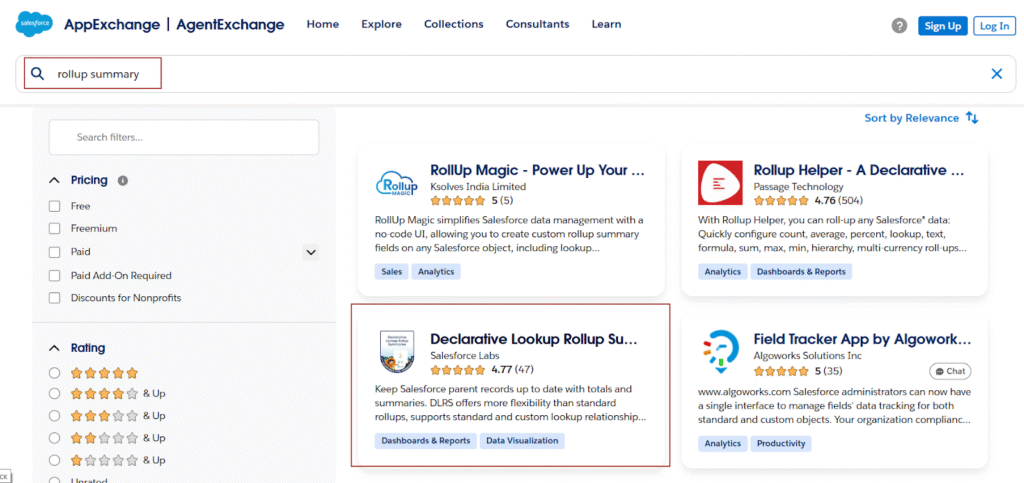
This makes AppExchange search highly keyword-driven. If your listing doesn’t clearly use the same language your target users search for, it will struggle to appear, even if the app itself solves the problem perfectly.
Why listing optimization matters comes down to how AppExchange search works. It evaluates relevance signals such as the words used in your title and descriptions, how closely they match real search queries, and how users interact with your listing through views and installs. Reviews and ratings further reinforce trust and real-world usage signals.
Because of this, AppExchange SEO doesn’t stop at filling out listing fields. Listings that perform best are usually supported by consistent educational content, such as app reviews, use-case articles, comparisons, and product explanations, created through content marketing services for Salesforce apps. This broader content ecosystem helps reinforce relevance, build trust before users even reach AppExchange, and ultimately improve listing visibility.
AppExchange SEO Basics
Before diving into listing optimization, it’s important to understand how AppExchange search works at a high level. AppExchange SEO is not the same as Google SEO, but it follows similar principles: relevance, clarity, engagement, and trust signals. These basics form the foundation of any effective AppExchange SEO strategy.
Insight:
AppExchange search prioritizes clarity over creativity. Listings that explicitly name the problem they solve and the Salesforce object or feature they work with (e.g., “rollup summaries for lookup relationships”) tend to outperform vague, brand-led titles, even when the products are technically similar.
What Influences AppExchange Ranking vs. What You Can Control
AppExchange ranking is driven by a mix of algorithmic signals and user behavior. While you can’t control the algorithm itself, you can directly influence how your listing performs within it.
| Ranking Factor | How It Affects Visibility | Can You Control It? | What to Optimize |
| Keywords & relevance | Determines whether your app appears for specific search queries | Yes | Title, tagline, brief description, metadata |
| Click-through rate | Signals relevance to AppExchange search | Partially | Clear value-driven copy, strong positioning |
| Views & installs | Reinforces listing popularity | Partially | Content clarity, visuals, CTAs |
| Reviews & ratings | Builds trust and supports ranking | Partially | Review collection strategy |
The table below shows which ranking factors you can influence directly and where optimization efforts have the biggest impact.
What influences AppExchange ranking:
- Keywords and relevance: AppExchange search relies heavily on text relevance. The words used in your title, tagline, brief description, and metadata determine whether your app appears for specific search queries.
- User engagement (clicks, views, installs): Listings that receive more clicks and installs signal higher relevance to Salesforce users. Poorly written or unclear listings often get fewer interactions, even if the app itself is strong.
- Reviews and ratings: Apps with more reviews and higher ratings tend to rank better. Reviews act as both a trust signal and an engagement indicator, influencing visibility and conversion at the same time.
Insight:
Reviews don’t have to live only on AppExchange. Publishing detailed, independent reviews and solution breakdowns outside AppExchange can strengthen trust and visibility at the same time. Strategic PR services for Salesforce apps, combined with ghostwriting for Salesforce apps through long-form reviews and educational content, often help apps attract warmer traffic and improve conversion rates once users land on the listing.
What you can influence directly:
- Content quality and structure: You control how clearly your app is described. Well-structured content that explains the problem, solution, and outcome improves both search relevance and user understanding.
- Screenshots and media: High-quality screenshots and videos increase time spent on the listing and improve conversion rates. Better engagement indirectly supports AppExchange search visibility.
- Metadata and positioning: Fields like SEO title, SEO description, categories, industries, and keywords help AppExchange index your listing correctly. Clean metadata ensures your app appears in the right searches and categories.
Understanding this split is critical. You can’t control how AppExchange ranks apps internally, but you can control how well your listing communicates value, relevance, and trust. Optimizing these areas consistently leads to stronger App visibility in AppExchange over time.
How to Do Keyword Research for Your AppExchange Listing
Choosing the right keywords is essential for AppExchange SEO. Effective keywords help your app appear for the search terms your target users actually use. Follow these steps to identify and prioritize the most relevant keywords:
- Start with Google search results
- Enter terms related to your app’s function, problem it solves, or target user.
- Look at the listings, articles, blogs, and AppExchange pages that appear in the top results.
- Identify keywords that are relevant to your app and that your listing could realistically rank for.
- This helps you see the language your audience uses and which phrases have real search interest.
- Analyze competitors or similar listings
- Review other apps in your category or solving a similar problem.
- Look at the keywords they emphasize in their titles, taglines, descriptions, and highlights.
- Take note of terms that generate visibility for them, and identify gaps or opportunities where your app can rank instead.
- Explore customer language
- Look at how your target users describe their pain points in forums, Salesforce community discussions, or LinkedIn groups.
- Capture the terms and phrases your audience actually types when searching for solutions.
- Check industry terminology
- Include role-specific, process-related, or industry-specific terms that your audience expects to see.
- Example: “declarative lookup rollup summaries tool,” “lookup rollups.”
- Use keyword research tools for validation
Tools like Google Keyword Planner, SEMrush, Ahrefs, or another can show:
- Search volume
- Competition/difficulty
- Related search terms or long-tail variations
These metrics help you prioritize the most valuable keywords to target.
Tips for using keywords:
- Focus on 1-2 primary keywords for your listing title and tagline.
- Include secondary keywords naturally in your brief description, highlights, and metadata.
- Avoid keyword stuffing – clarity and readability are essential.
DLRS Example Keywords:
For Declarative Lookup Rollup Summaries (DLRS), possible keywords could include:
- Primary focus keyword:
- DLRS
- declarative rollup summary
- Secondary keywords:
- Salesforce declarative lookup rollup summaries
- Rollup summary
- DLRS Salesforce
- declarative lookup rollup summaries tool
- Salesforce rollup tool
- rollup helper Salesforce
These keywords can be placed strategically in the title, tagline, brief description, highlights, and metadata to improve visibility in AppExchange search. Using external keyword tools can also help verify which terms are actively searched for by Salesforce admins and users.
Beyond keyword validation, many Salesforce teams also strengthen their AppExchange SEO strategy with long-form educational assets that support keyword clusters and user intent at scale. For example, professionally developed guides and ebooks help reinforce topical authority around specific Salesforce use cases and drive qualified traffic that is already pre-educated before reaching the listing. This is where professional Salesforce ebook writing can play an important role, as it helps structure content around real search behavior, product functionality, and Salesforce-specific terminology, ultimately improving both discoverability and conversion potential.
AppExchange Listing SEO Checklist
Below is a practical AppExchange listing optimization checklist, with explanations, SEO impact, and clear recommendations. All examples reference Declarative Lookup Rollup Summaries (DLRS).
AppExchange Listing Title
Explanation: The title is the most visible element of your listing. It appears in search results and strongly impacts click-through rate.
SEO Impact: Very high. The title is one of the strongest signals for Salesforce AppExchange ranking.
Best practices:
Your title should combine:
- the product or service name, and
- one main keyword users search for, not just a brand name.
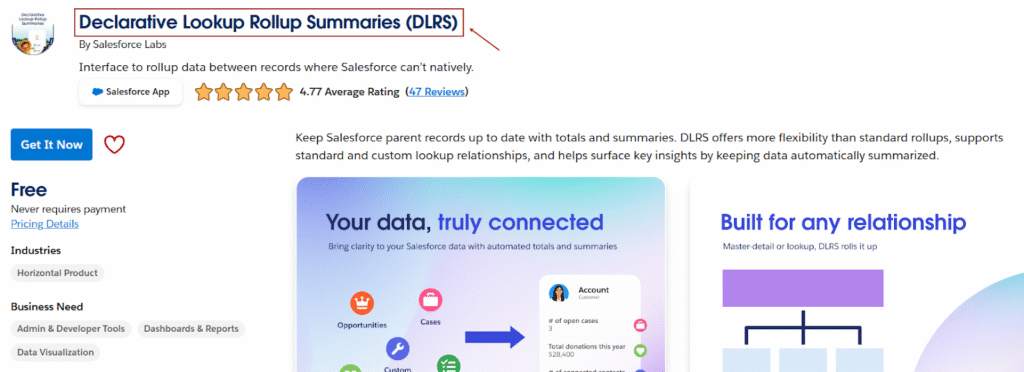
DLRS Analysis: The AppExchange listing title is “Declarative Lookup Rollup Summaries (DLRS)”. It clearly communicates the app’s functionality and includes the main keyword “Lookup Rollup Summaries,” which directly describes what the solution does. The title stays well within the character limit and focuses on a descriptive product function rather than just a brand name. Overall, it follows AppExchange SEO best practices and effectively signals relevance to both users and the AppExchange search algorithm.
Use Title Case, keep the wording concise, and avoid special characters or unnecessary marketing language. AppExchange search favors clear, descriptive titles over creative or brand-only names.
SEO Title for Salesforce App
Explanation: The SEO title is what appears in Google search results and other external search engines, as well as in AppExchange search listings. It is often the first thing potential users see, so it directly influences both click-through rates and ranking. A well-crafted SEO title clearly communicates what your app does and who it is for, making it easier for users to find and understand your solution immediately.

DLRS Analysis: The SEO title includes the main keyword “Declarative Lookup Rollup Summaries” and clearly describes the app’s function. This is good for relevance, but it exceeds the recommended ~70–75 characters. Shortening it will ensure full visibility in Google and AppExchange search results while keeping the key message.
SEO Impact: Very High – this is the single most important field for AppExchange SEO, as it strongly affects how your app ranks for search queries and how often users click on your listing from search results.
Recommendation:
- Use one main focus keyword that best represents your app and aligns with user search intent.
- Ensure the title conveys a clear, unified message, rather than a list of standalone keywords.
- Do not repeat the same keyword multiple times; it does not improve ranking and reduces readability.
AppExchange Listing Tagline
Explanation: The tagline is a short, one-line summary that explains how your solution helps customers succeed. It appears directly under your app title and reinforces your core value proposition.
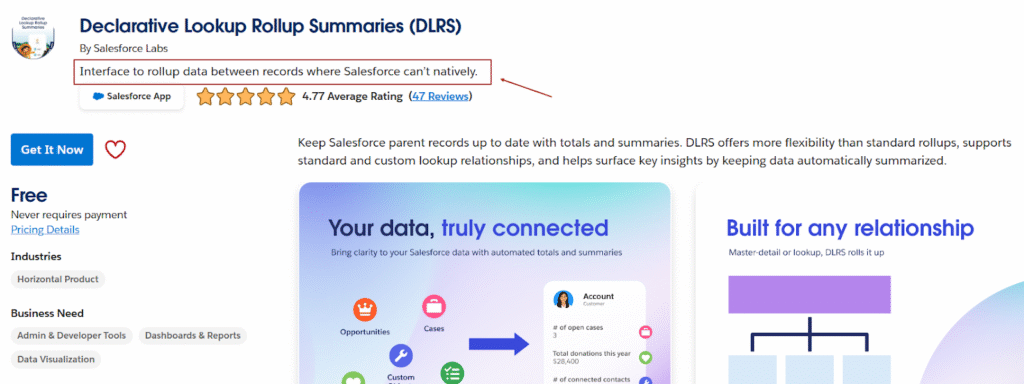
DLRS Analysis: The tagline clearly describes the main benefit, rolling up data where Salesforce cannot natively, and includes the keyword “rollup data.” It is concise, outcome-focused, and easy to understand, which supports both user clarity and SEO.
SEO Impact: High. Supports keyword relevance and user understanding.
Best practices:
- Focus on the outcome your users get, not how the technology works.
- Write with your ideal customer in mind (admins, sales teams, finance, support, etc.).
- Keep the language simple and clear so even a non-technical person can understand what your app does.
Pro Tip: Focus on outcome, not features. DLRS explains why it exists, not how it’s built.
AppExchange Listing Brief Description
Explanation: The brief description appears alongside your listing title in AppExchange and organic search results. It should clearly communicate what makes your solution unique and why users should choose it.
SEO Impact: Very high for AppExchange listing SEO optimization.
Length:
- Recommended: 150-200 characters
- Maximum allowed: 255 characters
Pro Tip
- Include 1-2 focus keywords that reflect how users search for your solution, and place them naturally within the first ~160 characters alongside your strongest value proposition. This helps AppExchange understand what your app is about while keeping the copy readable and persuasive.
- Structure your text as: Problem → Solution → Result. This improves readability and increases click-through rate. DLRS follows this structure clearly.
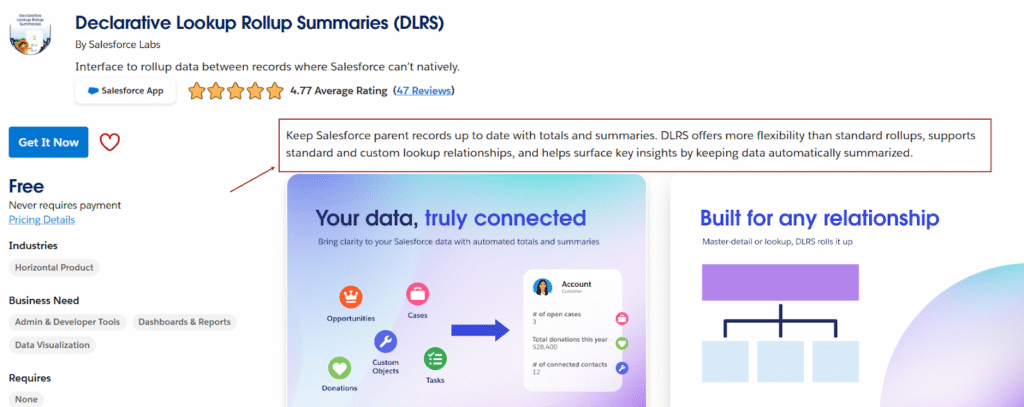
In the Declarative Lookup Rollup Summaries (DLRS) listing, the main keyword “DLRS” is used right away:

Here, the keyword DLRS is included naturally, the problem and solution are stated clearly, and the outcome/benefit is highlighted. This structure makes the listing both user-friendly and SEO-friendly.
Categories & Industries of AppExchange Listing
Explanation: These choices decide where your app shows up when people browse AppExchange by category or industry. If you pick the wrong ones, the right buyers may never find you.
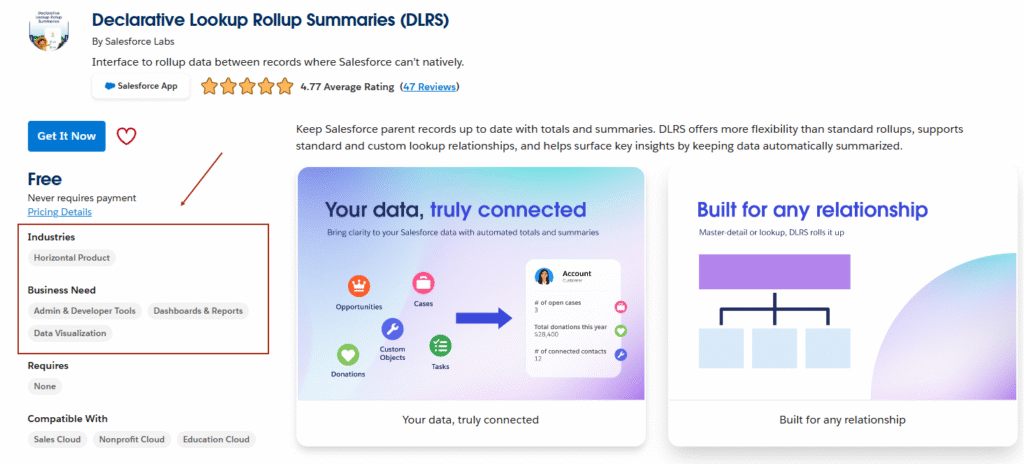
DLRS Analysis: DLRS is categorized as a Horizontal Product, targeting broad applicability across industries. The selected Business Needs: Admin & Developer Tools, Dashboards & Reports, and Data Visualization fully use the allowed limit of three per listing. These choices accurately reflect the app’s functionality, helping the right users discover it on AppExchange.
SEO Impact: Medium.
(They influence in-AppExchange discovery, not external or organic search.)
Limits: you can select up to 3 business needs per AppExchange listing.
Recommendation: Select only relevant categories. Over-tagging reduces relevance, especially when they don’t match your app.
Pricing Options of App
Explanation: Pricing is a required field on AppExchange. It helps users quickly understand how your solution is offered, builds trust, and sets clear expectations before they click through to install or learn more.
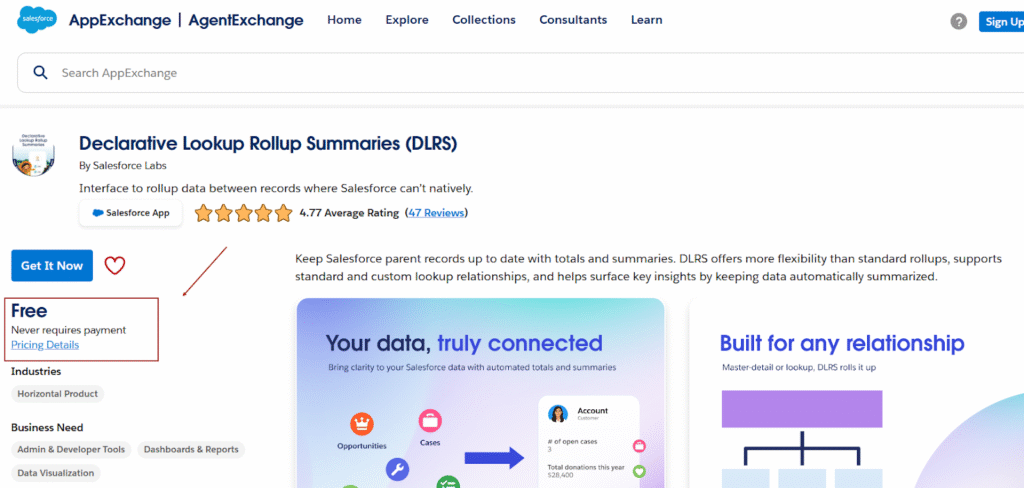
DLRS Analysis: DLRS is listed as Free, which is clearly indicated in the listing. This accurately reflects the app’s availability and helps set user expectations, supporting trust and conversion.
SEO Impact: Indirect, but important for conversion.
Available pricing models:
- Paid App:
Customers must pay to use this solution. A free trial may be offered, but payment is required after the trial period. - Paid Add-On Required:
Payment is required for some type of third-party service or product that your app depends on. - Freemium:
Your app is free to download, install, and use up to a limit. Payment is required after exceeding the limit. Examples of limits include number of users, data volume, feature access - Free:
Your app is always free. Any external or third-party products required must also be free.
Recommendation: Always select the pricing model that accurately reflects how your product is delivered.
Media (Screenshots & Video) for AppExchange Listing
Explanation: Screenshots and videos are crucial for helping users understand your app quickly. Strong visuals tell the story of your solution, reduce friction, and improve click-through and install rates. Well-prepared media also reinforces your listing text and highlights key benefits.
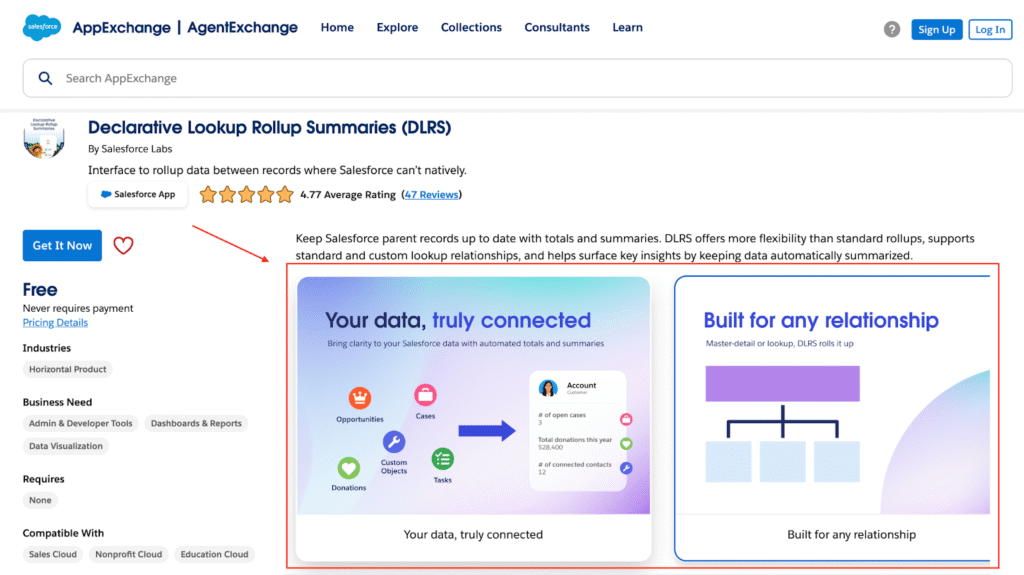
SEO Impact: Indirect, but strongly influences engagement metrics that AppExchange uses to evaluate listing performance.
Recommendations:
- Show how your app works through real screenshots and videos.
- Display screenshots inside device frames (computer, tablet, phone) for clarity and visual appeal.
- Include a short, one-sentence caption for each image or video. While captions are not directly indexed by AppExchange search, adding relevant keywords in captions can reinforce messaging, improve clarity, and support SEO indirectly.
- Include at least one demo video showing your app in action.
- Keep videos 2-4 minutes long and focused on actual workflows.
Be creative with your carousel:
- Customer quotes or logos
- Quantitative success metrics (e.g., % of time or cost saved)
- Supported integrations, industries, and geographies
- Awards or recognition from Salesforce or other experts
DLRS Analysis: The DLRS listing currently has strong visual assets, but there are no screenshots showing the actual app interface, which would help users understand workflows and functionality. Adding demo videos and interface-focused screenshots is recommended to improve user comprehension and engagement, even though this has only an indirect effect on SEO.
Highlights Block for App Listing
Explanation: Highlights are short, scannable lines summarizing your app’s main benefits or key use cases. They help visitors quickly understand what your app does and encourage them to read further or install. From an SEO perspective, these lines also contribute to keyword relevance because AppExchange indexes listing text and uses it to match search queries.
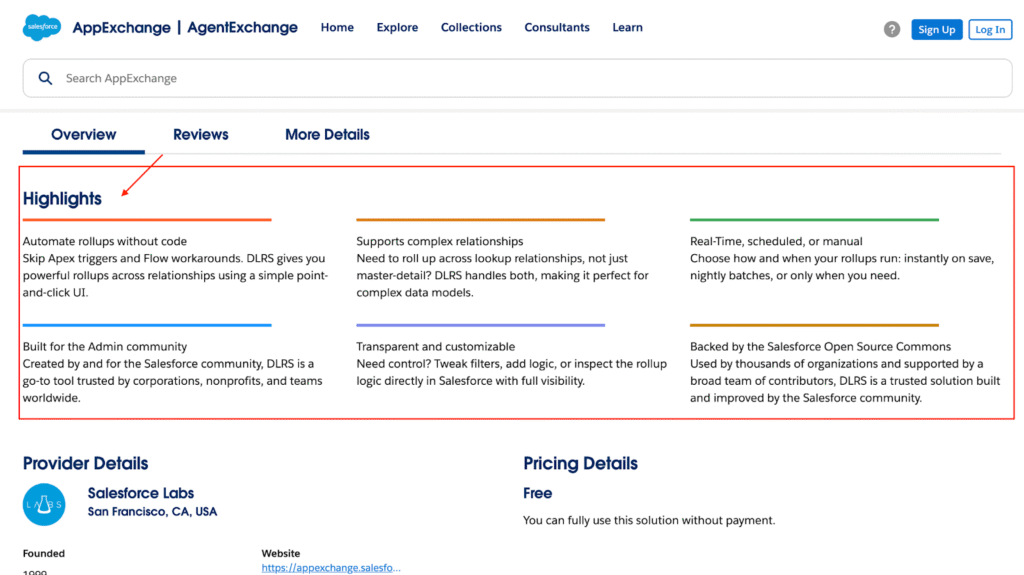
SEO Impact: Medium, including relevant keywords, can naturally improve visibility, strengthen your value proposition, and support user engagement.
Recommendation:
- Use keywords naturally in every highlight
- Each highlight should contain 1-2 keywords
- Match how users search, not how you market
- Users search for problems and solutions, not slogans.
- Your highlights should reflect Salesforce features (e.g., Leads, Opportunities, Lookup Relationships), User roles (Admin, Sales Ops, Support), Business problems (duplicates, reporting, automation, data sync).
- Use 5-6 highlights minimum
- This gives AppExchange more content to understand your app and gives users more reasons to stay on the page and click or install the app.
DLRS Analysis: The current DLRS highlights are well-written and reinforce the app’s core features, Salesforce context, and Admin use cases, which supports keyword relevance for terms like Automate rollups, lookup relationships, real-time rollups.
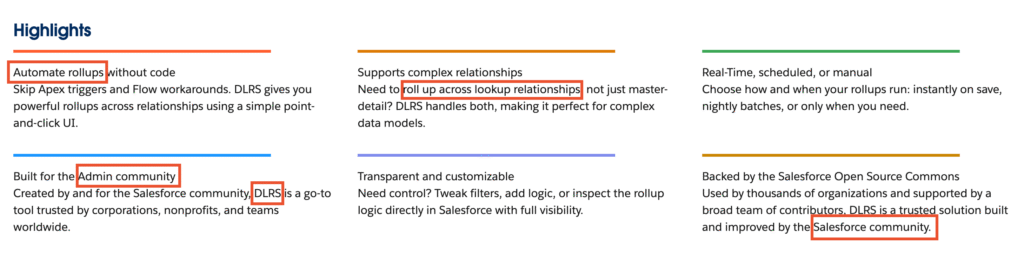
However, the listing currently uses 6 highlights. It is recommended to expand this to around 9 highlights to cover more app features and use cases, which also allows the inclusion of additional relevant keywords to improve SEO and better inform potential users.
AppExchange Listing Reviews
Explanation: Reviews are a critical trust signal for your app. They influence whether potential users click on your listing and proceed to install. The number of reviews appears in search results and is one of the factors directly influencing CTR, making it a very important part of AppExchange SEO.
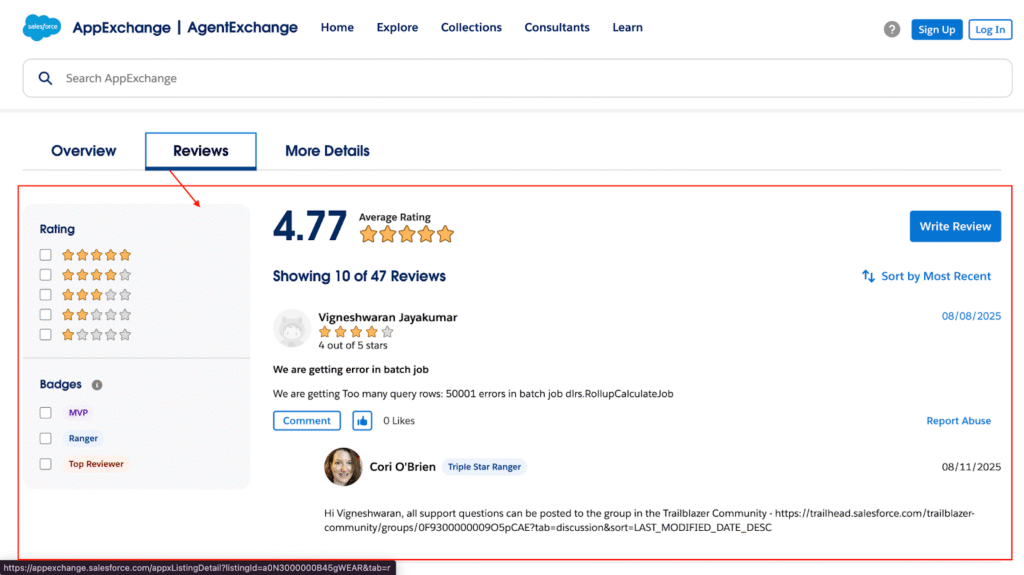
SEO Impact: Very High – the number and quality of reviews directly affect click-through behavior and listing performance, and AppExchange search also considers review ratings when ranking apps.
Pro Tip: Create a strategy on gaining new reviews inside the company. Prioritize getting reviews from satisfied users, and make sure to respond to reviews to show you value feedback.
DLRS Analysis:
- Average Rating: 4.77/5 – indicates high user satisfaction and builds trust for new prospects.
- Number of Reviews: 47 – a solid quantity that helps improve click-through rates in AppExchange search results.
- Implication for SEO & CTR: Both the high rating and review count are strong signals to AppExchange that the app is relevant and trusted, increasing the likelihood of ranking higher and being clicked.
Need more credibility for your Salesforce app?
A detailed, in-depth review of your solution on our website can boost brand authority and visibility.

CTA Buttons on AppExchange Listing
Explanation: CTA buttons tell users what to do next, like install the app or contact your team. Clear CTAs reduce confusion and improve conversions.
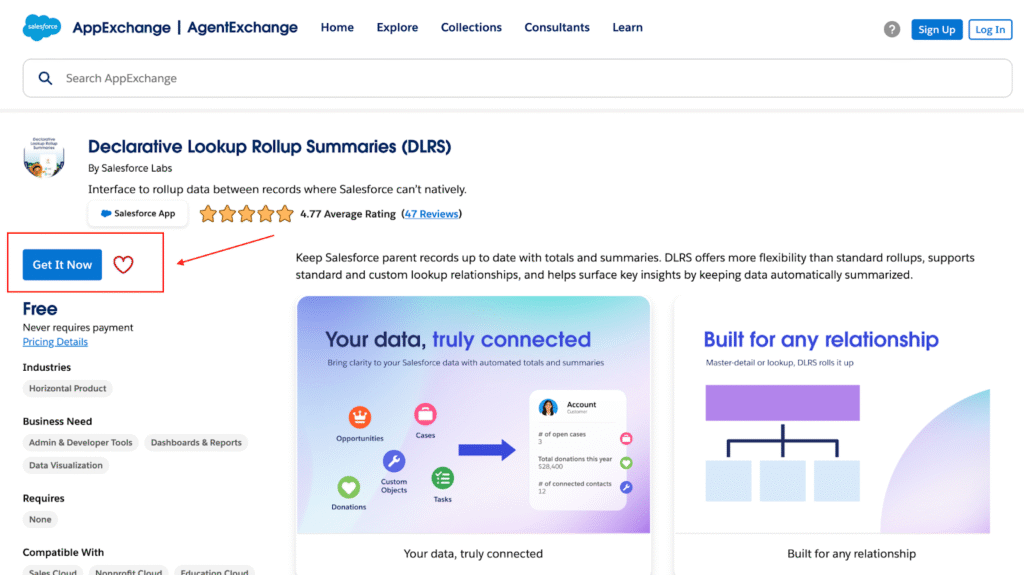
SEO Impact: Indirect, but essential for conversions.
Best Practice: Use clear CTAs: Get It Now, Try It Free, Contact Provider.
DLRS Analysis: Currently, the DLRS listing only uses the Get It Now button. While this enables users to install the app directly, adding other CTAs is recommended. Activating multiple CTA options can increase engagement, improve popularity signals, and give users alternative ways to interact with the listing. Though CTA buttons don’t directly affect SEO, higher engagement indirectly supports AppExchange visibility and conversion rates.
Common AppExchange Listing Mistakes to Avoid
Many listings underperform for simple, fixable reasons. Here are the most common AppExchange listing mistakes to watch for:
- Generic titles that don’t include any real keywords
- Descriptions packed with too many keywords, making the text hard to read
- No screenshots, or visuals that are blurry, outdated, or unhelpful
- Missing reviews, or reviews that haven’t been updated in a long time
- Pricing that is unclear or not explained
- No clear value proposition (users can’t quickly tell why the app matters)
If you fix these basics first, you usually see a quick improvement in clicks, engagement, and overall AppExchange search visibility.
Insight:
Apps with consistent listing updates (screenshots refreshed, descriptions improved, reviews added) often gain better AppExchange search visibility over time.
Final AppExchange SEO Checklist
Before you publish or update your listing, run through this quick checklist to make sure the essentials are covered. The checklist below reflects proven AppExchange listing best practices observed across high-performing Salesforce apps. These AppExchange listing optimization tips help improve visibility, clicks, and installs over time:
☐ Revevant title
☐ Optimized SEO Title
☐ Clear tagline
☐ SEO-friendly description
☐ Keywords added naturally
☐ Correct categories
☐ High-quality screenshots
☐ Video/demo added
☐ Reviews collected
☐ Pricing explained
☐ Сlear highlights
☐ Relevant industries
☐ Clear primary CTA
If most of these boxes are checked, your listing is in a strong position to improve AppExchange search visibility and convert more visitors into installs.
Conclusion
AppExchange listing SEO is no longer optional. With thousands of competing apps, only listings that clearly communicate relevance, value, and trust achieve consistent visibility and installs. A strong product alone is not enough, how your app is presented on AppExchange directly impacts whether users find it, click on it, and choose to install it.
By applying the optimization principles and checklist in this guide: improving titles, descriptions, media, reviews, metadata, and overall clarity – you can significantly increase your AppExchange search visibility and conversion rate without changing a single line of code. Strategic AppExchange content optimization ensures your listing communicates relevance, value, and trust to potential users.
A well-optimized AppExchange listing is often the fastest and most scalable way to grow adoption of your Salesforce app. If you need help auditing your AppExchange listing, our experts are always happy to review it and share actionable recommendations.

Svitlana is a Communications Manager with extensive experience in outreach and content strategy. She has developed a strong ability to create high-quality, engaging materials that inform and connect professionals. Her expertise lies in creating content that drives engagement and strengthens brand presence within the Salesforce ecosystem. What started as a deep interest in Salesforce later transformed into a passion at SFApps.info where she uses her skills to provide valuable insights to the community. At SFApps.info, she manages communications, ensuring the platform remains a go-to source for industry updates, expert perspectives, and career opportunities. Always full of ideas, she looks for new ways to engage the audience and create valuable connections.
 Previous Post
 Next Post