
From Early Chatbots to AI-Powered Finance Intelligence
The idea behind conversational AI is not new. One of the earliest predecessors of conversational AI, Joseph Weizenbaum’s ELIZA, was created at Massachusetts Institute of Technology in 1966. ELIZA was a simple rule-based chatbot that used pattern matching and scripted responses to simulate conversation. Its most famous script, called “DOCTOR,” imitated a psychotherapist by turning users’ statements into questions that encouraged them to continue the conversation, such as “Why do you feel that way?”
Although technically primitive, ELIZA revealed something important: users often became emotionally engaged with the system and treated its responses as meaningful. This phenomenon later became known as the “Eliza effect,” and it helped spark decades of interest in human-computer conversation.
One of the most recent major leaps came in the early 2020s with the rise of Large Language Models. Models such as OpenAI’s GPT-3 and later ChatGPT demonstrated that AI could generate natural, human-like responses through simple natural language prompts. Instead of learning how to create commands or use complex systems, users could simply ask questions in plain English and receive immediate answers.
This breakthrough quickly attracted attention across industries, including finance and operations. As conversational AI became more capable, organizations started exploring whether employees could interact with ERP, accounting, and payment systems through natural language in a similar way.
Insight:
AI adoption in finance is moving beyond experimentation.
By 2025, 59% of finance leaders already reported using AI within their finance functions, according to Gartner, while 67% said they felt more optimistic about AI’s potential, especially once their organizations moved beyond early pilot programs and started seeing measurable business impact.
As finance teams face growing pressure to deliver real-time visibility and faster decision-making, conversational AI for finance is emerging as one possible approach within the broader adoption of artificial intelligence in financial operations.
- Existing Approaches to Conversational AI in Finance
- Business Benefits of Conversational AI in Finance Powered by a Financial Intelligence Layer
- How to Install Kipper for NetSuite and Microsoft Teams or Slack Integration
- FAQs on Conversational AI Finance Integration with Kipper
- Final Takeaways: Building Reliable Conversational AI for Finance Beyond ERP Chatbots
Existing Approaches to Conversational AI in Finance
Instead of navigating complex ERP interfaces, manually building reports, or exporting spreadsheets to get insights, finance, operations, procurement, and sales teams want to ask questions like:
- “Any open invoices for the deals closing this quarter?”
- “What’s the lead time on backordered items?”
- “Which vendors have open purchase orders over $50k?”
and receive immediate answers.
However, existing approaches for implementing conversational AI in finance are far more complex than simply giving AI access to ERP data. Corporate data contains sensitive financial information, compliance requirements, permission controls, and highly customized ERP structures. Organizations cannot simply upload financial records into a public AI platform and expect accurate or secure answers.
As a result, companies begin looking for specialized conversational AI workflow automation finance solutions that can integrate intelligence into existing finance systems, such as NetSuite, through a natural language interface.
NetSuite AI Connector Service: Capabilities, Limitations, and Real-World Constraints
One of the first options many businesses explore is the NetSuite AI Connector Service. Since it is built directly for the NetSuite, it initially appears to be the most reliable and natural choice for enabling conversational finance AI.
The connector allows AI platforms such as Claude or ChatGPT to interact with NetSuite data and functions through predefined tools and APIs. These tools determine what information the AI can access and what operations it is allowed to perform, based on the permissions of the current user. When someone asks a question like “show last 5 transactions for vendor X,” the AI sends a request to NetSuite, retrieves the relevant data, and presents the answer in natural language.
This approach helps create shared context between AI and ERP systems and can even support actions such as updating records or triggering workflows. However, organizations quickly discover several limitations during real-world use:
1. Complex setup
Despite being part of the NetSuite ecosystem, the connector is far from plug-and-play. Organizations may need to configure tools, carefully manage permissions, and establish secure authentication flows to ensure sensitive data remains protected, which requires ongoing maintenance and technical expertise in both NetSuite architecture and enterprise security practices.
2. Hallucinated or incorrect AI-generated interpretation of ERP data
Reliability remains one of the biggest concerns in AI for finance, with 60% of enterprise leaders citing hallucinations and accuracy issues as a major barrier to AI adoption.
Finance teams cannot rely on “mostly correct” answers, as AI systems may produce inaccurate financial summaries, incorrect relationships between records, missing custom fields, or queries referencing data that does not exist. This often happens because NetSuite environments are highly customized, and AI models may generate incorrect financial summaries or misunderstand relationships between records.
3. Reliability and stability issues
Some organizations also report operational stability problems, such as expired authentication tokens, disconnected integrations, environment synchronization issues, or outages affecting AI providers. Since conversational finance workflows often depend on multiple systems working together simultaneously, even small disruptions can affect user trust, especially when only 46% of people report trusting AI systems.
4. Not ready for nontechnical users
The most important challenge is usability for everyday business teams. While administrators and technical analysts may be comfortable configuring prompts and validating outputs, nontechnical finance users often expect the system to “just work.” In practice, users may still need to understand ERP structures, phrase questions precisely, or manually verify AI-generated answers.
5. System fragmentation
Even with NetSuite connected, companies still rely on other systems for accounting, payments, and team collaboration. Since financial data is spread across multiple platforms, the AI often lacks a complete view. To generate accurate responses, it must either aggregate data from all relevant sources or make decisions with partial context, which can result in outputs that are incomplete, inconsistent, or unreliable.
Financial Intelligence Layer: A Structured Alternative
As businesses encounter the limitations of direct AI-to-ERP connectors, many begin evaluating a different approach – the financial intelligence layer.
Instead of exposing raw ERP data directly to AI tools, this layer sits between financial systems and the collaboration platforms employees already use for communication. Its role is to structure and contextualize financial information before AI interacts with it. This technique helps ensure that responses are based on organized financial data rather than AI interpretation or assumptions.
For Salesforce teams, this concept may feel familiar from the way Agentforce data must be trusted, governed, and connected to business context before AI can deliver reliable answers.
One platform following this approach is Kipper by Breadwinner. Rather than acting as just another ERP connector, it creates a financial intelligence layer between AI and financial platforms, enabling use cases such as NetSuite Teams integration. The solution brings together financial and operational data from systems such as NetSuite, QuickBooks, Xero, and Stripe, and makes it accessible directly inside Slack and Microsoft Teams chats, allowing employees to ask financial questions in natural language and receive immediate answers. This workflow can be tested in the public demo, where users can ask questions about invoices, AR, cash, and revenue using sample finance data.
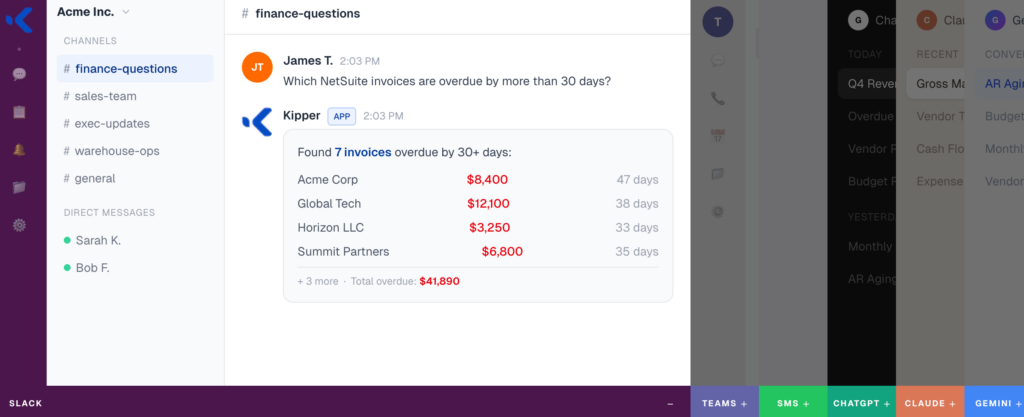
What makes this approach different is the way financial data is handled. Instead of relying on AI models to interpret complex ERP schemas, the platform structures information into clear financial objects such as invoices, payments, purchase orders, accounts receivable, and revenue data. User questions are translated into structured queries against this governed dataset, helping reduce hallucinations and improving answer accuracy.
The system also provides a shared financial context across multiple platforms. Financial data is often distributed across ERP platforms, accounting software, payment processors, and collaboration tools. These systems are frequently integrated together – for example, Stripe payment data may be synchronized into QuickBooks for accounting and reconciliation, while a subscription billing Salesforce integration with NetSuite can be used to synchronize revenue data across platforms. Instead of querying only one source, the tool can combine information across systems such as NetSuite, Stripe, QuickBooks, and Xero, providing more complete and context-aware responses.
| NetSuite AI Connector vs Financial Intelligence Layer: A Comparative Overview for Finance Teams | ||
|---|---|---|
| Aspect | NetSuite AI Connector Service | Kipper |
| Architecture | AI integration layer exposing NetSuite data/tools to LLMs via MCP/APIs | Financial intelligence and data unification layer |
| Data scope | Primarily NetSuite data, but can include external systems already synced into NetSuite | Multi-system finance visibility across NetSuite, Stripe, QuickBooks, Xero |
| AI accuracy | Depends heavily on ERP schema quality, prompts, permissions, and connected models | Provides a structured finance-specific semantic layer, reducing hallucinations |
| User experience | Technical/admin-oriented setup | Business-user-oriented conversational experience |
| Collaboration | Works through external AI platforms like ChatGPT, Claude | Is embedded into collaboration tools like Slack and Microsoft Teams |
| Permissions | Native NetSuite role/permission model | Configurable permission sets that define which financial data is visible, with access scoped by account type, transaction type, or role. |
| Write access | Allows governed actions/workflows through MCP tools and NetSuite permissions | Read-only access for analytics and conversational insights |
| Best suited for | ERP admins, technical finance ops, AI workflow builders | Finance teams and business users who want fast insights |
Business Benefits of Conversational AI in Finance Powered by a Financial Intelligence Layer
Implementing NetSuite Slack or Microsoft Teams integration via the financial intelligence layer delivers several practical advantages that improve how teams across the organization access, understand, and use financial data:
- Faster Adoption: Employees can ask financial questions without familiarizing themselves with new software, learning prompt engineering, or developing deep ERP knowledge. Natural language interaction reduces the learning curve for accessing operational and financial data and encourages faster adoption across departments.
- Better Collaboration: Financial answers appear directly inside the familiar messenger, making it easier for team members to share AI responses, discuss issues, and reference information without exporting data or switching between systems.
- Reduced Dependency on Finance Teams: On average, employees spend 41% of their workday on low-value tasks that do not contribute directly to organizational value creation. With a financial intelligence layer, sales, operations, and customer-facing teams can independently access approved financial information, reducing repetitive requests and enabling finance teams to focus on higher-value activities such as analysis, forecasting, and strategic planning.
- Improved Executive Visibility: Executives and managers can quickly ask high-level business questions without waiting for analysts, scheduled reporting cycles, or dashboard refreshes, enabling faster operational and financial decision-making.
- Unified Visibility Across Systems: By connecting multiple financial platforms, this approach gives teams access to shared, governed financial information in one place, reducing reliance on disconnected systems, manually consolidated reports, and fragmented data across ERP, accounting, and payment platforms.
In the next section, we’ll walk through how to install the app and connect it to your finance systems and messaging tools.
How to Install Kipper for NetSuite and Microsoft Teams or Slack Integration
Installing Kipper takes just a few straightforward steps, which don’t require complex development work.
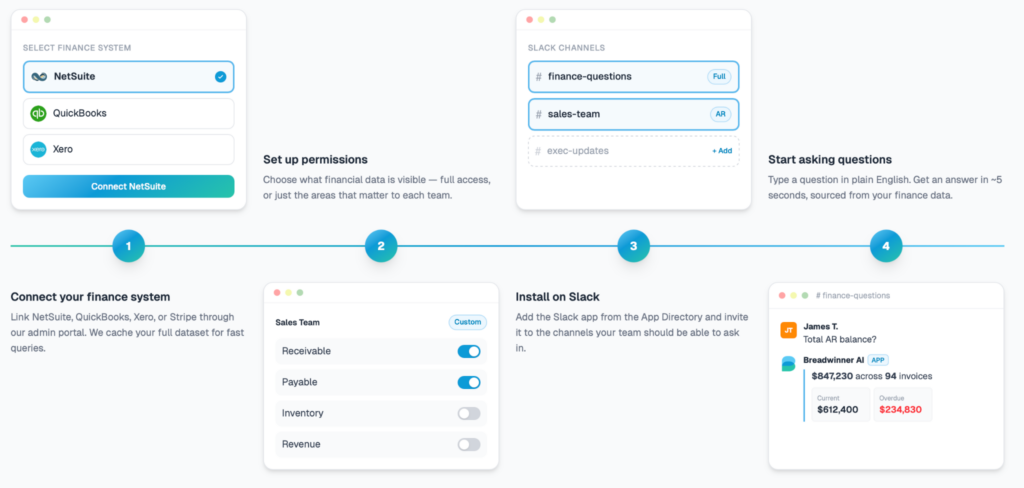
Step 1. Connect NetSuite: Link your NetSuite account through the secure admin portal. Once connected, your financial data will be cached and prepared for fast querying.
Step 2. Set up permissions: Define what financial data should be visible to each team. It can be either full access or restricted views based on roles, departments, or use cases.
Step 3. Connect your messenger: Install the app from the relevant marketplace (for example, the Slack App Directory for a NetSuite Slack integration and the Teams App Catalogue for Microsoft Teams) and add it to the channels where users will ask financial questions.
Once setup is complete, teams can immediately start using the system by testing real-world scenarios on their data in plain English directly inside the messenger and receiving answers in seconds.
FAQs on Conversational AI Finance Integration with Kipper
Below are some of the most common questions companies ask when evaluating the integration of conversational AI finance solutions, like Kipper, into their business processes.
1. How long does it take to set up the app?
Most teams can be up and running in under an hour. The tool is designed to be quick to deploy without requiring deep technical expertise. You need to just connect NetSuite through the admin portal, configure permissions, and connect Slack or Microsoft Teams using existing SSO credentials.
2. Can the app access my private channels or personal conversations?
No. The solution only operates in channels it has been explicitly invited to and approved for by administrators. Private channels remain private unless the app is manually added to them. You can also limit Kipper to specific channels and apply different permission sets for different users, teams, or departments within those channels.
3. Will my financial data be used to train AI models?
No. Financial data is kept secure in the SOC 2 Type II environment, and customer data is not used to train AI models. Data is not shared with third parties, and administrators can maintain control over which records and financial information users can access.
4. Can administrators see who asked each question and what data was accessed?
Yes. Every question and response is recorded inside the admin portal, including who asked the question, when it was asked, which channel it came from, and what financial data the response accessed. Admins can export these audit logs at any time, which helps maintain governance, accountability, and compliance.
5. What happens to my data if I cancel the service?
You can remove the app from Slack or Microsoft Teams at any time. Once disconnected, the tool immediately stops responding, and cached financial data is cleared within 24 hours. Audit logs are retained according to the organization’s configured data retention policy before being permanently deleted.
Final Takeaways: Building Reliable Conversational AI for Finance Beyond ERP Chatbots
Conversational AI can make ERP and accounting data easier to access, but only when the answers are grounded in a trusted financial context. Direct ERP-to-AI connectors can be useful, but they also require careful attention to permissions, accuracy, reliability, and fragmented data across systems.
As a result, organizations start exploring a financial intelligence layer approach, using tools like Kipper. Instead of letting AI interpret raw ERP data directly, this model structures financial information first into a governed layer that can be queried more consistently. This improves reliability and helps connect data across systems, while delivering answers through existing corporate messengers.
Introducing another integration tool or deploying a poorly performing AI chatbot will not meaningfully improve the use of AI in finance. The real opportunity lies in building a structured and governed foundation for corporate data that enables AI to deliver accurate, secure, and context-aware insights.

Mykhailo is a Salesforce Certified Platform Administrator with development experience in the fintech field. Since 2021, he has gained the Double Star Ranger rank on the Salesforce Trailhead education platform, where he acquired 26 Superbadges in Business Administration, Process Automation, Security, and more. With a decade of expertise in consulting and compliance, he aspires to translate complex technical concepts into accessible content, helping organizations make the most of Salesforce. Mykhailo is passionate about using technology for everyday needs, enjoys reading sci-fi and non-fiction books, and playing video games. He also has an interest in history and outdoor activities such as hiking, camping, and kayaking.
 Previous Post
 Next Post