

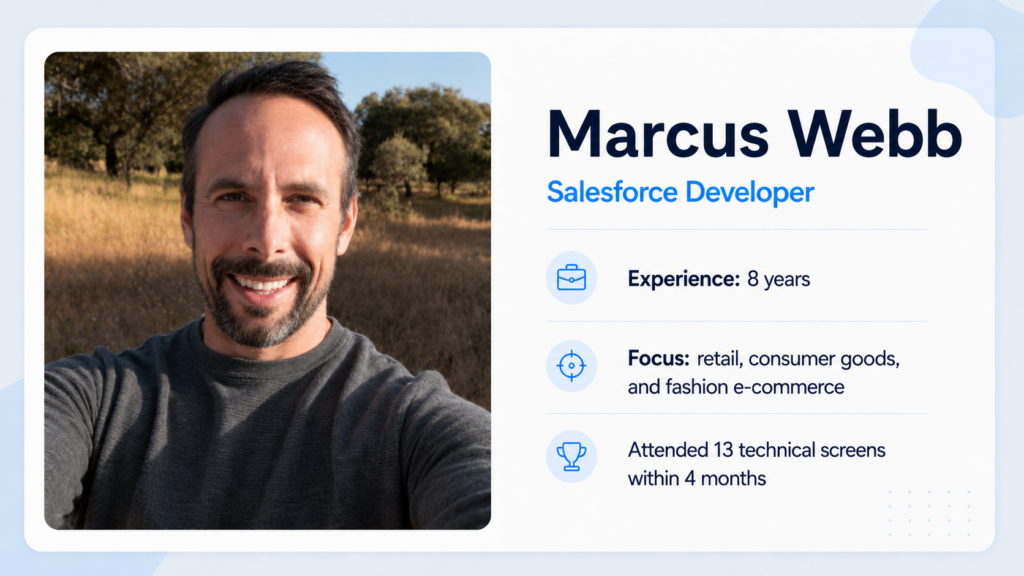
This post is contributed by Marcus Webb, a Salesforce Developer with 8 years of B2C Commerce Cloud and SFRA implementation work across retail, consumer goods, and fashion e-commerce clients.
The layoff came at the end of Q1, about 3 weeks after a platform consolidation I had been told was unrelated to headcount. Over the following 4 months I completed 13 technical screens: agencies, in-house retail teams, and one enterprise SaaS company building a B2C storefront on top of Commerce Cloud. The range surprised me. Some panels went straight to architecture. Others started with Business Manager basics and moved to SFRA only after a written exercise. The 20 questions below are what I actually saw.
Top 10 Most Frequently Asked Commerce Cloud Interview Questions
Every one of my 13 screens included at least 5 of these. Uncertainty on any answer below will surface before the technical round starts.
Q1. What is Salesforce Commerce Cloud and what are its two main product lines?
Commerce Cloud has two products. B2C Commerce (formerly Demandware) powers consumer storefronts with high catalog volume. B2B Commerce (Salesforce Platform) handles business buyer portals with account hierarchies and contract-based ordering. Both run on different stacks and serve different buyer profiles.
My read here: the interviewer wants the two named separately without prompting. Conflating them signals study-guide preparation.
Q2. What is SFRA and how does it differ from SiteGenesis?
SFRA (introduced 2018) uses a modular cartridge system with MVC separation and cartridge path ordering. SiteGenesis is the legacy pipeline-based architecture. Salesforce no longer develops SiteGenesis; all new projects start on SFRA.
I’d pay attention here: the pipeline-versus-controller distinction and cartridge override model matter more than saying SFRA is newer.
Q3. What is a cartridge and how does the cartridge path work?
A cartridge is a module of controllers, models, templates, and static files. The cartridge path is an ordered list defined in Business Manager; Commerce Cloud traverses it left to right and uses the first match. Custom cartridges placed earlier override base behavior without touching the original files.
My warning on this one: omitting path ordering reads as a developer who has modified base files rather than using the override pattern correctly.
Q4. How is Business Manager organized and what are its main functional areas?
The Organization layer manages users, roles, and global settings. Each Site has its own catalog, price books, campaigns, and cartridge configuration. Merchants manage catalog and promotions at site level; developers use Administration and Development areas for schemas, job scheduling, and code uploads.
I see this as a practical check: the interviewer wants confirmation you can navigate Business Manager without merchant support on every task.
Q5. How are product catalogs structured in Commerce Cloud?
Commerce Cloud uses a master catalog (all product records) and storefront catalogs (shopper-visible categories). A product must be in the master catalog first, then assigned to a storefront catalog category to appear on site.
My takeaway here: candidates who describe one catalog layer have not managed multi-site or multi-region projects.
Q6. What is a price book and how do price books apply to a storefront?
A price book maps products to prices for a currency and optional date range. A site can have multiple price books in priority order; Commerce Cloud returns the first valid price found. Sale books sit at higher priority and contain only promoted products.
I’d listen for this detail: the priority resolution sequence separates candidates who have diagnosed pricing bugs from those who have only configured price books.
Q7. How do promotions work in Commerce Cloud?
Promotions group inside campaigns. A campaign defines scheduling and qualifiers (customer groups, source codes, coupons). Each promotion defines discount logic at product, order, or shipping level and can add its own qualifiers. Both the campaign and promotion qualifier sets must be satisfied for a discount to apply.
I’d treat campaign logic as the signal here: candidates who omit campaigns have only built simple discounts without customer group segmentation or multi-qualifier logic.
Q8. What is OCAPI and when would you use it instead of the Scripting API?
OCAPI is a REST layer with three groups: Shop API (storefront interactions), Data API (Business Manager data), and Meta API (resource discovery). Use OCAPI for external integrations. The Scripting API runs inside the Commerce Cloud runtime and handles on-platform controller and job logic.
My check here is the internal-versus-external distinction, not just naming OCAPI. Skipping the three groups shows surface-level familiarity.
Q9. What is a custom object in Commerce Cloud and when do you use one?
Custom objects are schema-defined records stored outside the standard product, order, and customer models. Defined in Business Manager under Custom Object Definitions, they are accessed via Scripting API or OCAPI Data API. Use them for configuration tables, loyalty records, or runtime-readable metadata.
My red flag here: calling them extra fields signals the candidate has never built stateful platform data of any complexity.
Q10. How does the Commerce Cloud job framework work?
Jobs are configured in Business Manager under Administration > Operations > Jobs. Each job has steps implementing a JavaScript interface (beforeStep, process, afterStep) with chunk mode for large datasets. Jobs run on cron schedules or via the OCAPI Job Execution API.
I’d make chunk mode the deciding detail. Stopping at jobs-run-scripts-on-a-schedule is too thin for any feed processing work at catalog scale.
Insight:
For Salesforce roles in adjacent cloud products, the Salesforce revenue Cloud interview questions resource covers CPQ and Billing screen preparation that often pairs with Commerce Cloud roles at companies building unified quote-to-cash and e-commerce stacks.
5 Uncommon Commerce Cloud Interview Questions That Surprised Me
None of the standard prep content I found covered these before my first screen. 2 of them cost me measurable points in rounds I otherwise handled well. All 5 came from interviewers who were actively mid-implementation.
Q1. What is Page Designer and how does it differ from content slot templates?
Page Designer (introduced 2019) lets merchants assemble pages from pre-built component types without developer involvement. Content slot templates are the older pattern: developers define zones in storefront templates and merchants assign content assets to them. Page Designer gives full layout control; content slots give content control within developer-defined zones.
My note here: this signals you have worked closely with merchandising teams, not just with the cartridge codebase.
Q2. How does multi-site management work inside a single Commerce Cloud realm?
A realm contains multiple sites, each with its own storefront catalog, price books, locale settings, and cartridge path. Sites share the master catalog and organization-level user management. Site-specific cartridge paths let each storefront override behavior independently while sharing common base functionality.
In my experience with these screens, this is uncommon because most candidates have single-site experience. Multi-brand retailers ask it to screen for shared-infrastructure knowledge.
Q3. What powers Einstein Product Recommendations and what does a developer configure?
Einstein uses behavioral data from the Storefront Tracking script (clicks, add-to-cart, purchases) to train models. A developer embeds the script on relevant pages and configures recommendation zones in Business Manager. No ML configuration is required; models train automatically once sufficient data accumulates.
My read here: candidates know Einstein exists but cannot separate developer setup from what the platform handles automatically.
Q4. How do you configure search refinements and sorting rules in Commerce Cloud?
Search refinements are configured under Search preferences per site; each refinement maps to a product attribute and defines how values appear to shoppers. Sorting rules define attribute or score-based ordering. Both require a search index rebuild after changes to take effect on the storefront.
I’d call out the index rebuild step here: missing it reveals a developer who has never debugged a broken refinement after a catalog update.
Q5. What is the difference between a campaign qualifier and a promotion qualifier?
Campaign qualifiers activate every promotion inside the campaign (customer groups, source codes). Promotion qualifiers apply only to the individual promotion (minimum order, required products, coupon). Both sets must be satisfied simultaneously; a promotion qualifier adds to the campaign qualifier, not replaces it.
My practical check is the AND logic between qualifier sets. That is exactly where discount bugs appear when a condition is configured at the wrong level.
5 Tricky Commerce Cloud Interview Questions: What to Watch Out For
Each of these has a technically reasonable wrong answer. I gave at least 2 of them before understanding the mechanics well enough to respond correctly under pressure.
Q1. Can you safely extend an SFRA cartridge without modifying it directly?
Yes. Create a custom cartridge, place it earlier in the cartridge path, and replicate only the controllers or templates you need to change. Base files stay untouched. When Salesforce releases SFRA updates, only the files your cartridge explicitly overrides are affected; the rest update transparently.
My concern with a plain yes: saying yes without the cartridge path mechanism fails the immediate follow-up. Candidates who modify base files cannot answer.
Q2. What happens to active promotions when a campaign schedule expires?
All promotions inside the campaign stop firing when the campaign schedule expires, regardless of individual promotion dates. The campaign schedule is the outer constraint. Reactivating requires extending the campaign schedule or moving promotions to an active campaign.
I’d watch for this wrong answer: promotions run on their own dates. Candidates who have never handled a post-campaign cleanup make this mistake reliably.
Q3. Can a single product belong to more than one category in the storefront catalog?
Yes. A product can be assigned to multiple categories and appears in each category’s browse results. One primary category is used for breadcrumb display. In the master catalog, category assignment determines which attribute sets the product inherits.
My SEO check here: the primary category matters for the canonical URL path. Candidates without catalog SEO experience miss this consistently.
Q4. How does Commerce Cloud resolve prices when multiple price books overlap on the same product?
Commerce Cloud checks price books in priority order and returns the first valid price for the product and active currency. If the top-priority book has no entry, resolution falls through to the next. A book with no entry does not block resolution.
I’d correct this immediately: the wrong answer is that the lowest price wins. Priority order determines resolution, not price value comparison.
Q5. What is the difference between a product set, a product bundle, and a variation group?
A product set displays independent products together; each is added to cart separately. A product bundle is purchased as one unit at a bundle price. A variation group is a parent product with variants differing by attributes like size or color; shoppers select attributes to receive a specific variant.
My filter here is simple: this separates candidates who have built all three from those who have only read the definitions.
Insight:
If your company is on the other side of this process, the hire Salesforce Commerce Cloud developer guide covers what to evaluate in candidates and which skills separate a competent developer from one who can own a storefront end to end.
Final Recommendations: How to Pass the Commerce Cloud Interview
What 13 screens confirmed: depth on the cartridge system and the campaign-plus-promotion hierarchy separates Commerce Cloud specialists from generalists faster than any other topic. Both come up in nearly every technical round, and both have a confident-sounding wrong answer. Knowing the right answer is not enough if you cannot explain the mechanism when the interviewer follows up.
Business Manager time matters more than most candidates expect. Panels at merchant-led organizations tested whether I could navigate it directly. If you have not built a promotion from scratch, run a job manually, or rebuilt a search index after a catalog update, that gap will show in a practical exercise round.
Prepare specifically for multi-catalog structure, price book resolution order, and the SFRA cartridge override pattern. The tricky questions in this list exist because the wrong answer is not obviously wrong, which is what makes them effective interview filters and why targeted preparation outperforms general Commerce Cloud study.

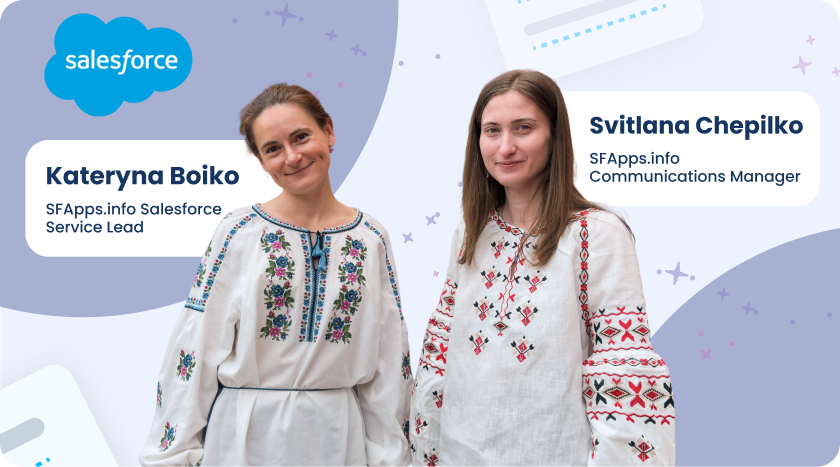
Svitlana is a Communications Manager with extensive experience in outreach and content strategy. She has developed a strong ability to create high-quality, engaging materials that inform and connect professionals. Her expertise lies in creating content that drives engagement and strengthens brand presence within the Salesforce ecosystem. What started as a deep interest in Salesforce later transformed into a passion at SFApps.info where she uses her skills to provide valuable insights to the community. At SFApps.info, she manages communications, ensuring the platform remains a go-to source for industry updates, expert perspectives, and career opportunities. Always full of ideas, she looks for new ways to engage the audience and create valuable connections.
 Previous Post
 Next Post