

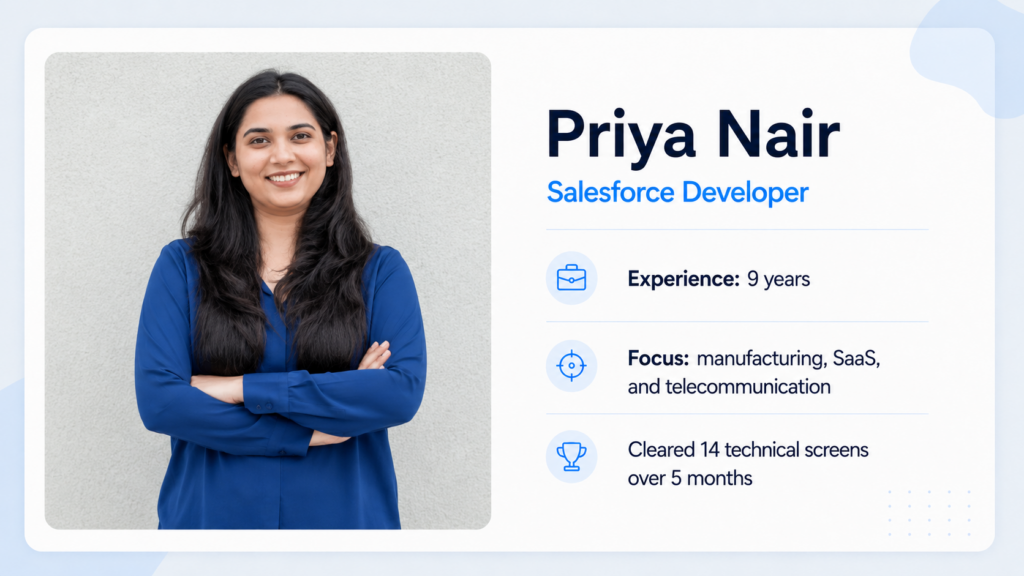
This post is contributed by Priya Nair, a Salesforce Developer with 9 years of hands-on CPQ and Billing implementation experience across manufacturing, SaaS, and telecommunications clients.
My situation last October: acquired company, redundant team, role eliminated within the month. I had not interviewed in 3 years and Revenue Cloud was my entire specialization. Over the next 5 months I cleared 14 technical screens. What I was not ready for was how differently each company framed the same topic: a SaaS startup cared about product catalog architecture, a telecom client went deep on Billing triggers, and a financial services firm put me through a live pricing waterfall exercise in round two. The 20 questions below document what I actually saw, with the answers that worked and the ones I had to rebuild after early failures.
Top 10 Most Frequently Asked Revenue Cloud Interview Questions
At least 10 of my 14 screens opened with 3 or more of these. Treat this section as the baseline: if any answer below still feels uncertain, that gap needs to close before anything else.
Q1. What is Salesforce Revenue Cloud and how does it differ from CPQ?
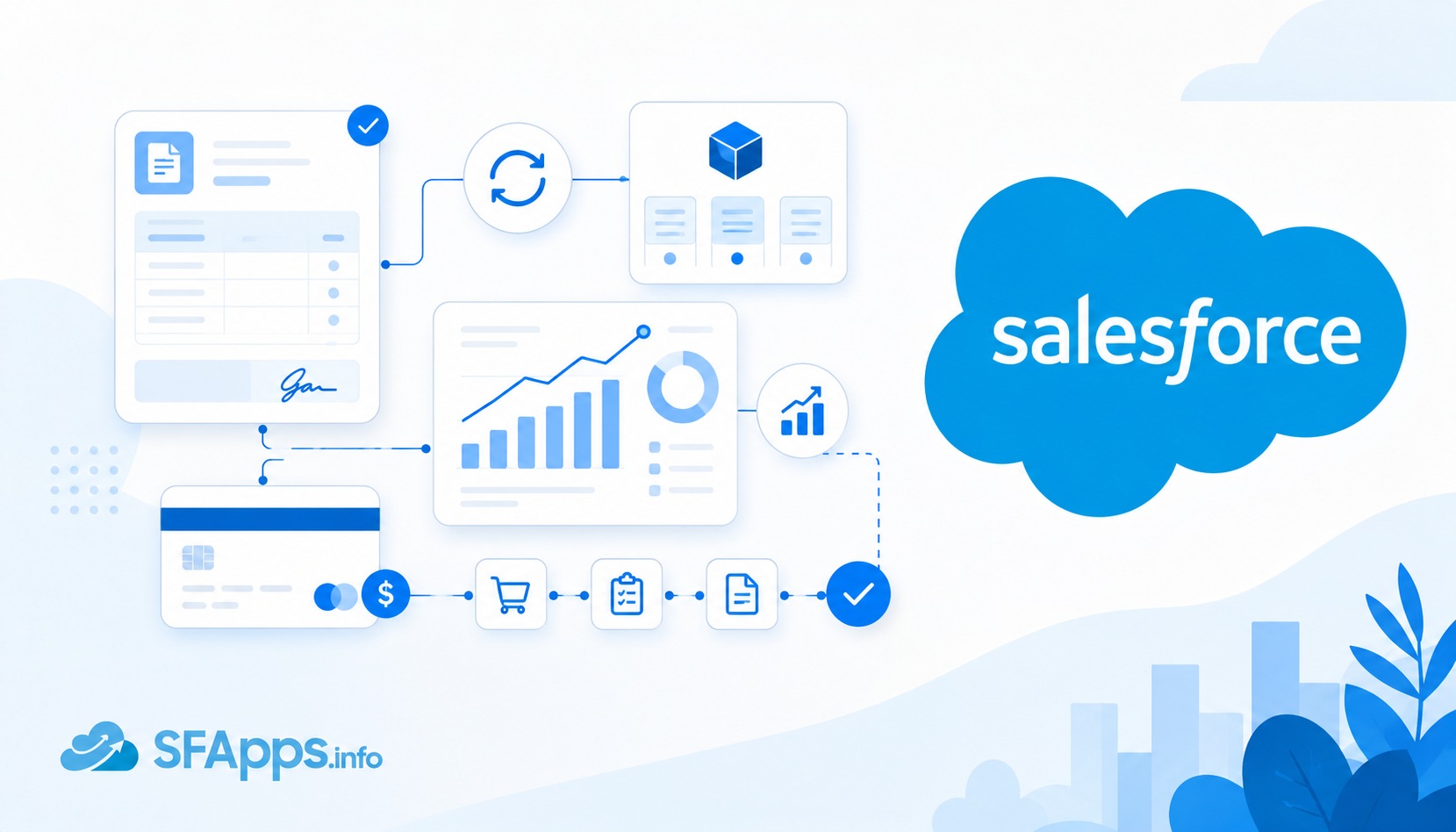
Revenue Cloud combines CPQ (quoting), Salesforce Billing (invoicing and payments), and Revenue Lifecycle Management (RLM). CPQ handles product configuration and quote generation. Revenue Cloud extends that into the post-quote world: order creation, invoicing, payment processing, and revenue recognition. CPQ handles the sale; Revenue Cloud handles everything the sale triggers downstream.
From my point of view, technical interviewers want the downstream framing. ‘CPQ with Billing added’ is the weak version. The signal they look for is whether you see connected stages or separate tools.
Q2. Walk me through the standard quote-to-cash flow in Revenue Cloud.
Opportunity, Quote, CPQ configuration and pricing, approval, contracting, Order creation, Order activation, Order Products to Billing, Invoice Run, Invoice posted, payment collected, revenue recognized. Key objects: Quote, Quote Line, Order, Order Product, Billing Schedule, Invoice, Invoice Line.
My read here: name the object at every stage without prompting. Describing the process in business terms only signals business analyst familiarity, not implementation depth.
Q3. What is a Product Rule in CPQ and what types exist?
Product Rules enforce business logic in the CPQ configurator. Four types: Alert (message only, no block), Validation (blocks save until resolved), Selection (auto-adds, removes, or hides products), Filter (restricts which products are available). Each uses Error Conditions to define when it fires and Product Actions to define what it does.
From my experience, mixing up Alert and Validation is the single most common mistake I saw in debrief notes from a previous employer. Know all four types and have a concrete Selection rule example ready for the follow-up.
Q4. How does pricing work in CPQ? Explain the pricing waterfall.
Fixed sequence: List Price, Cost-Plus, Special Price, Customer Price (from Price Rules), Partner Price, Net Price after Discount Schedules, Additional Discounts, Contracted Price. Price Rules can write into any field in this sequence. Discount Schedules apply specifically at the Net Price stage based on quantity or term tiers.
The question that tripped me early was this: where do Price Rules inject versus where do Discount Schedules apply? They are not the same stage. Mixing them signals documentation familiarity without production debugging experience.
Q5. What is a Price Rule and how does it differ from a Discount Schedule?
A Price Rule writes a value to any quote line field based on conditions, using Lookup Queries or Summary Variables as input and Price Actions as the write mechanism. A Discount Schedule applies tier-based discounts at the Net Price stage based on quantity or term bands. Price Rules are general-purpose; Discount Schedules are purpose-built for volume pricing.
I would call out the precision here: different waterfall stages, different configuration paths, different use cases.
Q6. What is a CPQ bundle and how do you configure one?
A bundle is a parent product grouping components the customer configures together. Setup: mark the parent’s Configuration Type as Allowed or Required, add component products as Product Options, apply Option Constraints to prevent incompatible combinations, organize using Feature Categories. Pricing sits at the bundle level or rolls up from components per the Component Pricing Method setting.
What I listen for here is Option Constraints. Describing a bundle at the parent-product level only signals a demo setup. Knowing how to lock out incompatible combinations shows a real product catalog.
Q7. How does Salesforce Billing generate invoices and what triggers the process?
Billing invoices from Order Products with active Billing Schedules. Three required fields per Order Product: Billing Type (Advance or Arrears), Billing Frequency, Billing Start Date. An Invoice Run scans eligible schedules, groups them into Invoice Lines, combines those into an Invoice record, and posts it.
In my screens, Advance versus Arrears is where candidates with CPQ-only backgrounds stumbled. Getting Billing Type wrong in a live org means customers are invoiced at the wrong time. Every Billing-heavy screen I had probed this distinction.
Q8. What is a Contracted Price and how is it used in CPQ?
A Contracted Price locks a negotiated rate to a specific account-product combination through the Contract record. When a rep quotes that account and product, CPQ pulls the Contracted Price automatically, overriding standard list and customer pricing. It sits at the bottom of the waterfall. Contracted Prices are typically generated automatically when a CPQ quote is contracted.
From my point of view, the real test is whether you understand automatic price creation from the contracting process. Describing it as a ‘special discount field’ signals no hands-on renewal quoting work.
Q9. What is the difference between an Amendment and a Renewal in CPQ?
An Amendment modifies an active contract mid-term: adding, removing, or repricing lines, with proration for the remaining period. A Renewal creates a new quote for the next contract term before the current one expires. Both read active Subscriptions as their starting state.
I would frame this as mid-term versus next-term. The real follow-up is proration: how does CPQ calculate the prorated amount? Candidates who cannot answer that have not processed a real amendment.
Q10. What are Subscriptions in CPQ and how do they relate to Contracts?
A Subscription is created per recurring product line when a quote is contracted. It stores product, price, quantity, and term dates. Subscriptions are the source of truth for both Amendments (which read active Subscriptions to build the starting quote state) and Renewals (which populate lines from them for the next term).
The phrase I would use is ‘source of truth for the contract lifecycle.’ Interviewers ask this specifically to confirm you understand why Subscriptions exist as a separate object rather than just reading data directly off the original Quote Lines.
5 Uncommon Revenue Cloud Interview Questions That Surprised Me
None of the prep resources I used before my first screen covered these. 3 cost me meaningful points in early rounds. All 5 came from interviewers who were actively mid-implementation, not just hiring.
Q1. How does Revenue Cloud connect to Revenue Lifecycle Management (RLM) and what does RLM add?
RLM is Salesforce’s next-generation revenue platform. Where current Revenue Cloud runs CPQ and Billing as two separate managed packages, RLM unifies them into a single product catalog and contract asset lifecycle model. It adds native metered usage billing, evergreen subscriptions, and milestone billing without custom code. Many orgs are currently evaluating whether to stay on CPQ and Billing or begin an RLM migration path.
Three of my screens included this, and each company was mid-evaluation on the RLM decision. What the interviewer wanted was not RLM configuration depth but evidence I was tracking the platform roadmap. Not knowing RLM exists reads as out of touch, even with strong CPQ skills.
Q2. What is a Summary Variable in CPQ and when would you use one instead of a formula field?
A Summary Variable aggregates values across multiple Quote Lines and makes the result available to Price Rules and Product Rules. Sum, count, or average a field across lines matching filter criteria. A formula field only computes at the individual line level. Use a Summary Variable when a rule depends on combined totals across the whole quote.
From my point of view, this question filters candidates who have built cross-line pricing logic from those who have only configured simple Price Rules against a single line. Almost no prep guide explains this dependency.
Q3. How do you handle usage-based pricing in Revenue Cloud today?
Standard CPQ and Billing have no native metered billing object. Collect consumption data via Platform Events or custom objects, then use Apex or Flow to create Invoice Lines before the Invoice Run fires. RLM changes this: it introduces Usage Procedures and Usage Inputs that handle metered billing as a configuration, not a custom build.
In my experience, this appears at companies with consumption-based products evaluating the CPQ stack’s limits. Confidently answering that ‘CPQ handles usage pricing’ is the wrong answer this question is designed to catch.
Q4. Explain how CPQ handles multi-currency quoting and what the limitations are.
CPQ inherits Salesforce Advanced Currency Management. List prices are stored in corporate currency; currency-specific list prices require separate Price Books per currency. Exchange rates are captured at quote creation and do not update automatically if rates change after the quote is issued.
Both times this appeared for me, it was the deciding question for a senior role at a global company. Most prep materials treat multi-currency as optional background. At international sales teams it is a hard requirement, and the rate snapshot behavior is the specific gap that surfaces in post-mortems.
Q5. What is the role of the Order object in Revenue Cloud and how does it bridge CPQ and Billing?
The Order is the handoff point. A contracted CPQ quote converts into an Order; Quote Lines become Order Products. Order Products carry Billing Type, Frequency, and Start Date. Activating the Order signals Billing that these products are ready for invoice generation. Activating before Billing fields are correctly set on the Order Products produces incorrect schedules and requires data correction to fix.
I see this as a bridge question: it reveals whether the candidate owns the full data flow or only the module they worked in most. Both of my live Billing implementations had at least one activation timing issue to clean up. That firsthand experience is what makes the answer concrete.
5 Tricky Revenue Cloud Interview Questions: What to Watch Out For
Each of these has a confident-sounding wrong answer. I gave at least 2 of them in early screens before I understood the actual mechanics well enough not to fall into the framing.
Q1. Can you activate an Order after it has been invoiced in Salesforce Billing?
No. Activation fires before invoicing and is a one-time trigger. Once Billing Schedules are generated and Invoice Runs have been processed against them, reversing requires voiding invoices and regenerating billing records through a deliberate data correction process, not a field update.
My warning here is the word ‘after’: it implies activation is a reversible status. It is not. Candidates who have not run a staging invoice cycle answer that activation can be toggled at any point.
Q2. Does CPQ respect the standard Salesforce Approval Process, or does it use its own system?
CPQ has its own native approval engine: Approval Rules, Approval Chains, and Approval Variables, configured entirely within CPQ package objects. Standard Approval Processes still work on Quote records but are not CPQ-aware and can conflict with CPQ’s quote locking. Use one system consistently, not both.
From my point of view, developers from non-CPQ backgrounds assume all Salesforce objects share the same approval infrastructure. That assumption is wrong for CPQ. Certification materials do not always make this clear, which is exactly why it keeps appearing as a filter question.
Q3. If a Price Rule and a Discount Schedule both apply to the same product, which one takes effect?
Neither wins automatically. Discount Schedules apply at Net Price. If a Price Rule runs after the Discount Schedule and writes to Net Price, it overwrites the schedule result. The Sort Order field on Price Rules controls execution sequence. Without deliberate sequencing, both can appear to work in isolation while producing inconsistent results when they apply simultaneously.
My check here is whether the answer avoids a flat ‘Price Rules win’ or ‘Discount Schedules win.’ The correct answer is that Sort Order determines it, and the real skill is setting up sequencing so they do not conflict.
Q4. What happens to a CPQ Subscription if the associated Contract is manually deactivated?
Nothing cascades. CPQ’s contract lifecycle is process-driven, not status-driven. Changing the Contract status field directly does not terminate the associated Subscriptions. They remain active and continue populating amendment and renewal quotes. The supported cancellation path runs through a CPQ amendment that removes the products, updating Subscriptions correctly.
In my experience, standard Salesforce backgrounds make people assume status changes cascade. CPQ breaks that assumption. Admins who bypass the amendment flow to simplify a cancellation leave orphaned Subscriptions that resurface on the next renewal cycle. This question finds candidates who have seen that problem in production.
Q5. Is it possible to invoice a customer before the Order is activated?
Not through the standard billing flow. Invoice Runs only pick up Order Products on an active Order with a valid Billing Schedule. An admin can create a manual Invoice record directly, bypassing the standard lifecycle, but that introduces reconciliation and revenue recognition risk that is very difficult to clean up retroactively.
The way I would answer this is not to stop at ‘technically yes, with a manual Invoice.’ The stronger version names the reconciliation risk immediately. Interviewers at mature Billing orgs are asking whether you understand the consequences, not whether the workaround exists.
Insight:
Salesforce certified cloud consultant for hire guide can help Revenue Cloud teams avoid engagement mistakes before the first sprint starts.
Final Recommendations: How to Pass the Revenue Cloud Interview
The pattern across 14 screens: candidates who stumble do not lack knowledge. They lack specificity. Vague answers about the quote-to-cash process, generic pricing rule descriptions, textbook-level Amendment and Renewal definitions: these read as certification prep, not implementation experience. The candidates who advance can name the object, the field, the error they saw, and what they changed to fix it.
Practically: trace a complete transaction in a real org before any senior screen. Run an amendment. Process an Invoice Run manually. Trigger the proration calculation on purpose and understand the math behind the result. If you have not done this in a staging environment, set one up.
Have a position on RLM. Even a preliminary one based on publicly available Salesforce documentation is enough. 3 of my 14 screens included an RLM question; none of the standard prep resources I used beforehand mentioned it. Prepare the 5 tricky answers specifically so they come out clean under pressure: activation as a one-time trigger, Subscriptions not cascading from a manual status change, Sort Order controlling the pricing mechanism conflict. These are the details interviewers use to verify implementation depth over certification knowledge.
Salesforce QA interview questions can also help candidates preparing for QA-track roles, since quality-assurance screens often pair with Revenue Cloud roles on larger implementation teams.

Svitlana is a Communications Manager with extensive experience in outreach and content strategy. She has developed a strong ability to create high-quality, engaging materials that inform and connect professionals. Her expertise lies in creating content that drives engagement and strengthens brand presence within the Salesforce ecosystem. What started as a deep interest in Salesforce later transformed into a passion at SFApps.info where she uses her skills to provide valuable insights to the community. At SFApps.info, she manages communications, ensuring the platform remains a go-to source for industry updates, expert perspectives, and career opportunities. Always full of ideas, she looks for new ways to engage the audience and create valuable connections.
 Previous Post
 Next Post