



This post is contributed by Jordan Reeves, a certified MuleSoft Integration Developer and Salesforce specialist with 9 years of experience building enterprise API integrations across financial services and retail.
I was laid off from a fintech company last fall after 4 years as lead MuleSoft developer. I updated my certifications and spent 3 months going through 12 technical screens for MuleSoft and Salesforce integration roles. Some ran structured DataWeave exercises and architecture whiteboarding; others were entirely conversational. The 20 questions below are drawn directly from those rounds, with the answers I gave and my read on what each interviewer was actually testing.

Top 10 Most Frequently Asked MuleSoft Interview Questions
These came up in at least 8 of my 12 screens. Whether you are working through anypoint platform interview questions or broader architecture topics, know these cold.
Q1. What is MuleSoft’s Anypoint Platform and how does it differ from a traditional ESB?
Anypoint Platform unifies API design, runtime, management, and monitoring in one product. A traditional ESB routes messages through a proprietary hub; Anypoint’s API-led approach routes them through versioned, published APIs instead. The runtime is Mule 4, deployable on CloudHub, Runtime Fabric, or on-premises.
From my point of view, the interviewer wants both models named and wants to hear why API-led is a step beyond ESB. Naming all 3 deployment targets signals real production experience.
Q2. What is a Mule flow and what are its main components?
A flow has a source, a chain of processors, and an optional error handler. Sub-flows inherit the caller’s error handling and are reusable within that error scope. Private flows run on the same thread but do not expose an endpoint and do not inherit error context.
In my view, every screen included a follow-up on when to choose sub-flow versus private flow. Get that distinction right before anything else.
Q3. How does DataWeave 2.0 differ from MEL (Mule Expression Language)?
MEL was Mule 3’s inline scripting language. DataWeave 2.0 is a functional, stateless transformation language supporting JSON, XML, CSV, and flat files natively. In Mule 4, MEL is no longer supported; DataWeave replaces it throughout.
What I noticed is that mentioning streaming support for large payloads prompts a useful follow-up on memory management. These DataWeave interview questions came up in every screen I did.
Q4. Explain API-led connectivity and its three layers.
System APIs abstract core systems (ERP, CRM, databases). Process APIs orchestrate business logic and call System APIs. Experience APIs face end consumers and shape data for each audience. Each layer deploys and versions independently.
The way I would read this, the interviewer listens for why the layers exist. The key point: System APIs protect backends from direct consumer calls, making the architecture resilient when underlying systems change.
Q5. What is the difference between scatter-gather and the for-each scope?
Scatter-gather sends the same message to multiple routes in parallel and aggregates results. For-each iterates over a collection sequentially, setting the payload to each item per iteration. All scatter-gather routes receive the original message unchanged.
The mistake I heard often is that the common wrong answer is that scatter-gather is just parallel for-each.
Q6. How does error handling work in Mule 4?
on-error-continue catches, executes its processors, and returns the last payload without re-throwing. on-error-propagate catches, executes, and re-throws. Error types follow a hierarchy (MULE:CONNECTIVITY, HTTP:UNAUTHORIZED) and can be caught by specific type or parent category.
I would treat the key follow-up as this: what does the HTTP caller receive when on-error-continue handles a listener failure? A 200 with the handler’s payload, not a 500. Getting that backwards is a common tell.
Q7. How do you secure a MuleSoft API in production?
Three layers: HTTPS transport, API Manager policies (OAuth 2.0, JWT, client ID enforcement, rate limiting), and application-level RBAC. API Manager policies apply through autodiscovery without modifying application code.
I would judge this answer by whether autodiscovery is mentioned. It is the detail that separates enterprise governance experience from standalone app development. Know it by name.
Q8. What is the Object Store and when do you use it?
Object Store is Mule’s built-in key-value store used for idempotency, caching, and token storage. Object Store v2 (OSv2) is shared across CloudHub workers and is required for horizontally scaled deployments where state must be consistent.
This answer earns trust when it moves from “key-value store” to in-memory versus distributed state. On multi-worker or RTF deployments the distinction is critical. Mention OSv2 proactively.
Q9. What are the main differences between JMS and Anypoint MQ?
JMS requires managing a broker (ActiveMQ, IBM MQ). Anypoint MQ is MuleSoft’s managed service with direct Anypoint Platform integration and no broker overhead. Use JMS for protocol interoperability or existing licensed brokers; Anypoint MQ for greenfield MuleSoft-to-MuleSoft work.
This is where I look for trade-off reasoning, not a feature list. Articulating when you would choose each signals maturity.
Q10. What is the difference between synchronous and asynchronous processing in Mule 4?
A synchronous flow processes on the same thread; the caller waits for the response. An async scope offloads work to a different thread pool and the original thread continues immediately without waiting.
The answer gets stronger when it explains the thread-pool handoff, not just “sync waits and async does not.” That is what separates candidates who have debugged thread starvation from those who have only read theory.
5 Uncommon MuleSoft Integration Interview Questions That Surprised Me
These came up in only one or two of my 12 screens, usually with senior technical panels. Knowing them signals production depth.
Q1. How does MuleSoft handle large file processing without running out of memory?
Mule 4 supports streaming by default. DataWeave processes large payloads with ‘output application/json streaming=true’ and connectors stream bodies without loading them into heap memory. Avoid materializing the payload into a Java object; process it as a reactive stream.
From my personal experience, this comes up mainly around CloudHub worker memory limits and EDI integrations. If you have that background, bring it up proactively rather than waiting to be asked.
Q2. What is raise-error in Mule 4 and how does it differ from Java’s throw?
There is no throw keyword in Mule 4. The raise-error component raises custom errors in namespace:identifier format (e.g., ORDER:VALIDATION_FAILED). It integrates cleanly with on-error scopes and the error type hierarchy.
I see this question as a test of Mule-native thinking in candidates with Java backgrounds. Explain the Mule error model on its own terms rather than mapping it to exception handling.
Q3. How do you implement idempotent message processing in MuleSoft?
Use idempotent-message-validator with a DataWeave expression extracting a unique ID. On duplicate, it raises MULE:DUPLICATE_MESSAGE. For multi-worker deployments, configure it to use OSv2 so the ID store is shared across workers.
I would expect this question in roles built around event-driven architecture and guaranteed delivery. Prepare it if the job description mentions exactly-once processing.
Q4. What are the key architectural differences between CloudHub 1.0 and CloudHub 2.0?
CloudHub 1.0 uses shared infrastructure with vCore allocations. CloudHub 2.0 is containerized with private space support and explicit CPU/memory per replica, replacing vCores with precise resource definitions.
I have seen plenty of teams still running on CloudHub 1.0. Be honest about where direct experience ends. The interviewer who asked me appreciated that honesty immediately.
Q5. What is the Until Successful scope and what are its production risks?
Until Successful retries processors until success or max retry count, then raises MULE:RETRY_EXHAUSTED. Risk: retries block the processing thread for the entire retry window, potentially exhausting the thread pool under frequent failures.
This is where the answer stops being standard. The thread-blocking behavior under failure load is the trap. Raising it unprompted demonstrates production credibility.
5 Tricky MuleSoft API Interview Questions
These have correct answers that differ from instinct. Even candidates with 3 to 5 years of Mule experience get at least 2 wrong under interview pressure.
Q1. What is the precedence order for error handlers in Mule 4?
Flow-level error handler first, then global, then Mule’s default (log and propagate). A flow with its own handler bypasses the global completely.
My read on this one: interviewers phrase it as “where does Mule look first?” to catch candidates who say “global.” Flow-level is correct.
Q2. If an HTTP request connector times out, what specific error type does Mule raise?
HTTP:TIMEOUT. Distinct from MULE:CONNECTIVITY (connection failure). Catch it by specific type rather than the broader MULE:ANY parent.
My take here: the mistake I see most often is calling it MULE:CONNECTIVITY. Knowing the precise error type hierarchy is what the interviewer is actually testing.
Q3. Does Mule 4 support distributed transactions across multiple systems?
Mule 4 supports XA for JMS, JDBC with XA drivers, and the VM connector. HTTP is not transactional; it cannot be included in an XA transaction. For non-XA systems, compensating transactions or saga patterns apply.
My caution here: “yes, Mule supports XA” is incomplete. The trap is naming a system that does not support XA. Interviewers ask this to find the boundary of your knowledge.
Q4. What happens to the original payload after a scatter-gather completes?
Scatter-gather replaces the original payload with a collection of results, one map per route. The original payload is gone after the scope finishes. Store it in a variable before the scatter-gather if needed downstream.
I learned to watch for this assumption: developers expect the original payload to survive. It does not. In three of my 12 interviews this was a deliberate follow-up specifically to catch that assumption.
Q5. Can a sub-flow be called from a private flow, and who governs error handling?
Yes. Error handling is governed by the error handler of the flow that was originally called the private flow. Private flows do not propagate their own error handling upward. Sub-flows never have their own error handlers.
My note on this one: nested flow-refs are where people lose the error propagation chain under pressure. Say explicitly if you have traced this in production
Insight:
If you are a hiring manager staffing integration projects quickly, the hire Salesforce developers guide covers engagement models worth reviewing first.
Final Recommendations for Your MuleSoft Developer Interview
From my personal experience, the single differentiator in MuleSoft screens is explaining why you made a decision, not just what you built. Practice every answer with a brief ‘I chose this over the alternative because’ clause. Spend two to three hours writing DataWeave in Anypoint Studio before any screen. Prepare one production incident story. Know your error type hierarchy: HTTP:TIMEOUT versus MULE:CONNECTIVITY versus MULE:ANY catches people every time.
If your target roles include Salesforce e-commerce work, reviewing Salesforce commerce cloud interview questions will round out your Salesforce ecosystem preparation.
- Know the error type hierarchy cold: HTTP:TIMEOUT vs. MULE:CONNECTIVITY vs. MULE:ANY.
- Be honest about CloudHub 2.0 and RTF gaps. Claiming depth you do not have is easy to expose in a 10-minute drill.
- Prepare one production incident story. Follow-up questions from it reveal more than any direct technical question.
The MuleSoft interview questions and answers above reflect 12 real screens. Every set of mulesoft developer interview questions came back to the same test: can you reason under pressure about systems you have actually owned. Practice live DataWeave, know your error types.

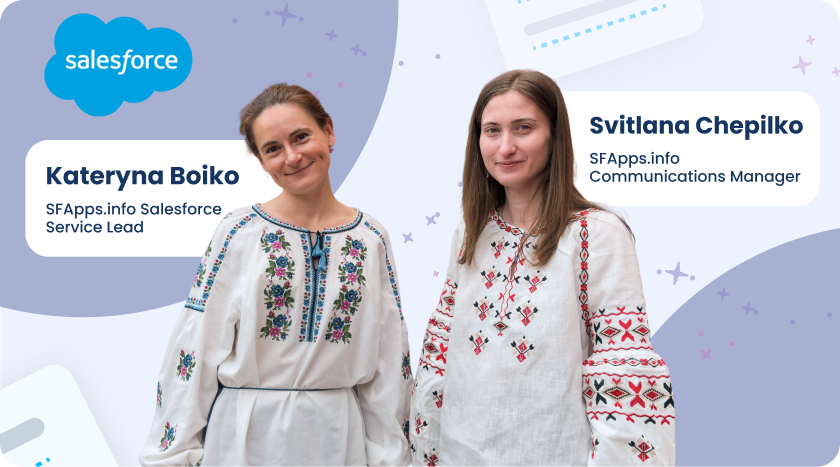
Svitlana is a Communications Manager with extensive experience in outreach and content strategy. She has developed a strong ability to create high-quality, engaging materials that inform and connect professionals. Her expertise lies in creating content that drives engagement and strengthens brand presence within the Salesforce ecosystem. What started as a deep interest in Salesforce later transformed into a passion at SFApps.info where she uses her skills to provide valuable insights to the community. At SFApps.info, she manages communications, ensuring the platform remains a go-to source for industry updates, expert perspectives, and career opportunities. Always full of ideas, she looks for new ways to engage the audience and create valuable connections.
 Previous Post
 Next Post